
IoT Platform for Smart Agriculture
Know your fields before you walk them.
Soil, silos, herds, wells, and greenhouses, connected in minutes. TagoIO turns the data into forecasts and alerts: when the feed runs out, when to irrigate, which animal is behaving strangely. No dev team? Describe your solution in a prompt and TagoAI assembles it, on the same reliable platform.
 Rated 4.9/5 on G2 Behind agtech products like BinVision and ViehFinder
 Built for agtech companies, OEMs, co-ops, growers, and research teams.
Live simulations. The same analyses run on real farms today.
feed-bin-07grain level · barn 2
Level OK · empty in 23 days
- 06:00 connector: feed-bin-07 online via LoRaWAN · level payload decoded
Drag the feeding rate. Watch the empty date move and the refill order fire before the outage. This is what BinVision runs in production.
Applications
Six things farms monitor with TagoIO today
Silo & feed monitoring
Level sensors report grain continuously. TagoIO projects the empty date, alerts before an outage, and can create the refill order. No more climbing bins for a manual check.
Sensors: laser and ultrasonic level, load cells · LoRaWAN, cellular
BinVision case studyLivestock tracking
GPS trackers and ear tags stream location and activity. Geofence alerts when an animal leaves the pasture; behavior anomalies flag health issues before they spread.
Sensors: GPS neckbands, accelerometer tags · LoRaWAN, satellite
ViehFinder case studySoil & crop monitoring
Moisture, EC, and NPK probes across fields feed irrigation and fertilization decisions. Trends per zone show what a walk-through never would.
Sensors: soil moisture, EC, NPK probes (Dragino, Milesight) · LoRaWAN, NB-IoT
Browse soil sensorsWater & well level monitoring
Wells, tanks, reservoirs, and troughs report levels in real time. Forecast drawdown, protect pumps from running dry, and alert before livestock lose water.
Sensors: submersible pressure, ultrasonic level · LoRaWAN, cellular
Browse level sensorsGreenhouse control
Temperature, humidity, and CO2 sensors close the loop with actuators: vents, lights, and pumps respond automatically to keep conditions in range year-round.
Sensors: climate, CO2, PAR light · WiFi, LoRaWAN
Browse climate sensorsWeather stations
On-farm stations plus third-party weather APIs drive frost alerts, spray windows, and irrigation forecasts tuned to each field, not the county average.
Sensors: rain, wind, temperature, humidity stations · LoRaWAN, cellular
Browse weather stationsResults
Real farms, on the record
Silo monitoring · Envision / BinVision
Feed outages cut, bin climbing eliminated
- Feed outages, the number one problem for hog and poultry operations, drastically reduced through consumption forecasting
- Emergency procurement replaced by planned purchasing
- "No more climbing bins": dangerous manual inspections eliminated
- Faster incident response through automated alerts
Read the case study"TagoIO's full-stack platform allowed us to deliver a real-time solution that's powerful, user-friendly, and cost-effective: exactly what our customers needed."
Livestock tracking · ViehFinder
24/7 cattle tracking where phones lose signal
- Live tracking on high alpine pastures with poor mobile reception, via LoRa
- Solar-powered neckbands: no battery swaps on the mountain
- Hours of searching for animals replaced by a map
- Serving a market of ~500,000 cattle grazing the Alps each summer
Read the case study"ViehFinder is a system for monitoring grazing livestock that works reliably even in high alpine regions and with poor mobile reception."
Research
Your algorithm is the thesis. The infrastructure is ours.
University groups use TagoIO as the data backbone for field research: sensors stream into managed storage, and researchers run their own Python or Node.js models on live data without building a single server. Test an irrigation algorithm against a real growing season, not a CSV from last year.
Data stays accessible: full API, export anytime, share dashboards with the lab or the funding committee. The free plan covers prototypes and small trials, and student projects graduate to production without migrating.
Several universities run agricultural research on TagoIO. We would love to name them here; they prefer we don't, and we respect that.
# Your model, our pipeline
from tagoio_sdk import Analysis

def irrigation_model(context, scope):
    soil = scope.get("soil_moisture")
    forecast = my_algorithm(soil)  # the part you publish
    context.save("irrigation_forecast", forecast)
TagoAI
Describe the solution. TagoAI assembles it.
You do not need a development team to get started. Tell TagoAI what you want in plain language, and it builds the pieces: device setup, dashboards, alerts, forecast analyses. Everything it creates is a standard TagoIO resource you can open, inspect, and change, so nothing is a black box.
We are careful with AI promises. TagoAI does not run your farm, and it does not replace the people who know it. It removes the technical steps between an idea and a working solution, running on a platform that has to be solid and reliable whether AI is involved or not.
Developers: wire your own models into analyses too. Gemini, ChatGPT, or any model with an API, from Python or Node.js.
"Alert my phone when any feed bin will run empty within 5 days, and show all bins on one map."
Created 3 resources for your review:
- Analysis: bin-empty-date forecast, runs on every level reading
- Action: push notification at the 5-day threshold
- Dashboard: map of all bins with live level widgets
Review each resource before it goes live. You can edit anything TagoAI builds.
Sensors & Devices
Pre-integrated agricultural sensors
Pre-built connectors decode payloads from Dragino, Milesight, TEKTELIC, Novus, and hundreds of other manufacturers. Connect over LoRaWAN for remote fields, satellite where there is no network at all, or NB-IoT, cellular, and WiFi.
Soil
Moisture, temperature, EC, and NPK probes for field zones and orchards.
Levels
Laser and ultrasonic sensors for silos, water tanks, wells, and troughs.
Animals
GPS neckbands, ear tags, and activity sensors for herds of any size.
Climate
Weather stations, greenhouse climate sensors, CO2, and leaf wetness.
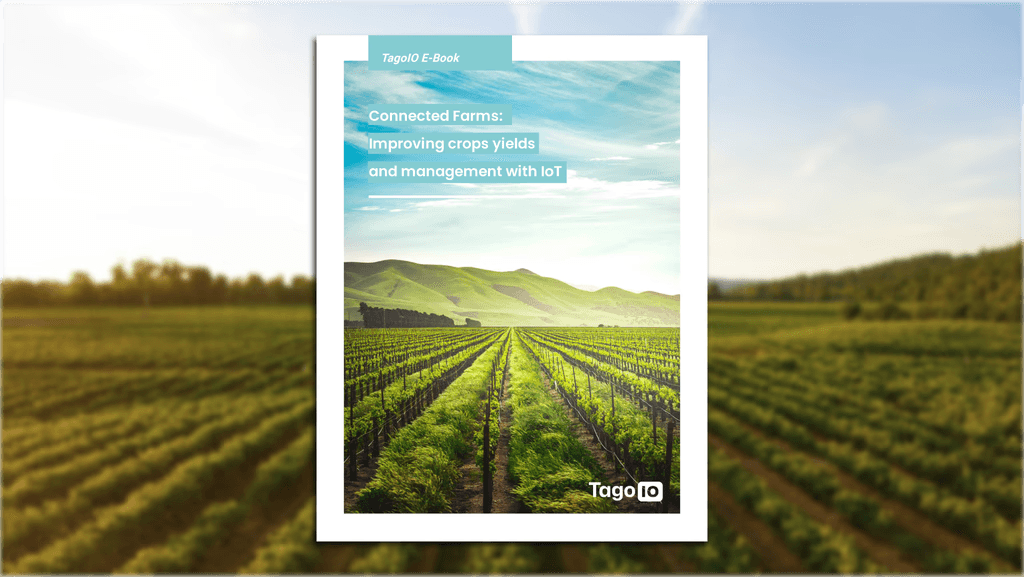
Connected Farms eBook
How IoT sensors improve crop monitoring, water use, and yields, with practical implementation guidance from real deployments. Free download.
Get the eBook