
Every IoT platform prices differently, and every pricing page looks reasonable at pilot size. But the bill that matters is not the pilot bill. It is the invoice that arrives after the fleet grows tenfold, the message frequency doubles because a customer wanted faster updates, and the data retention policy quietly became a compliance requirement. Two platforms that cost the same at 50 devices can differ by a factor of five at 5,000, purely because of how the meter is built. So the right way to compare pricing models is not “which is cheapest today” but “which can I predict well enough to put in a three-year budget.”
Four models cover almost everything on the market. Each one optimizes for something different, and each one surprises you somewhere.
Per-device pricing: predictable by design
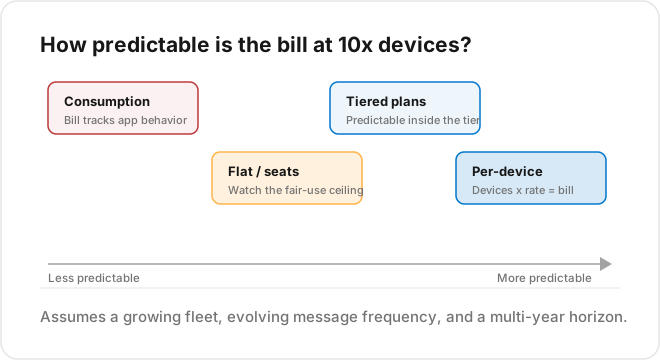
A fixed price per connected device per month. Multiply devices by rate and you have the bill, which makes it the easiest model to defend in a budget meeting and the easiest to pass through to your own customers if you resell.
The surprise hides in the definition of “device.” Some vendors count anything with an ID, including virtual devices, gateways, and integrations. Others tier the device price by message volume, which quietly turns per-device into consumption pricing. Read the definition before you model anything.
Consumption pricing: pay for what you use, predict what you cannot
Metering on messages, data points, storage, or compute. Cloud infrastructure made this model standard, and hyperscaler IoT services like AWS IoT Core price this way. It is genuinely cheap at low volume and it scales smoothly, with no step changes.
The problem is that consumption is a property of your application’s behavior, not your contract. A firmware change that doubles reporting frequency doubles the bill. A chatty device model, a debugging period, a customer that wants one-minute updates: all of it lands on the invoice. Consumption works when you control the data pipeline tightly and can enforce reporting discipline. It punishes teams that cannot.
Tiered plans: predictable until the cliff
Fixed monthly fee covering a bundle: so many devices, so much data, so many users. Inside the tier, perfectly predictable. The surprise is the cliff at the boundary, where device 1,001 forces the jump to a plan sized for 5,000 and the unit economics lurch.
Map the tier boundaries against your realistic growth curve before signing, and check what happens to historical data if you ever need to step down a tier.
Flat and seat-based pricing: simple, until usage is the product
A flat platform fee, sometimes with charges per user seat. Simple to budget and generous at high device counts. But vendors cannot sustain flat pricing against unbounded usage, so the limits reappear in fair-use clauses and throttling policies. Flat pricing is honest only when the ceiling is written down.
The predictability test
Whatever the model, three questions expose most surprises before the contract does.
First, what happens to my bill if devices grow 10x? If the answer requires a spreadsheet with more than one variable, budget risk lives in that spreadsheet.
Second, what happens if message frequency doubles with the same device count? That isolates the consumption exposure.
Third, which line items are metered that I do not directly control? Storage retention, API calls made by integrations, and alert volume are the usual hidden meters.
Predictability also has a second-order benefit: it is what lets you price your own managed service with confidence, because you cannot sell a fixed monthly fee downstream while carrying an unbounded meter upstream.
Which model wins
For most mid-market deployments and nearly all resellers, per-device or tiered pricing wins, not because the total is always lower but because the variance is. Consumption pricing wins for lean, well-instrumented teams with strict control over reporting behavior. Flat pricing wins when the vendor writes the ceiling into the contract.
TagoIO publishes its rates on the pricing page, and the fastest way to sanity-check any platform’s model is to run your realistic year-three fleet through it, not your pilot. For the full cost picture beyond the platform fee, including integration and operations, see comparing IoT platform pricing over a three-year horizon. And if you are still assembling the shortlist, start with the IoT platform buyer’s guide.
Ready to model your own numbers? Book a demo or start free.