
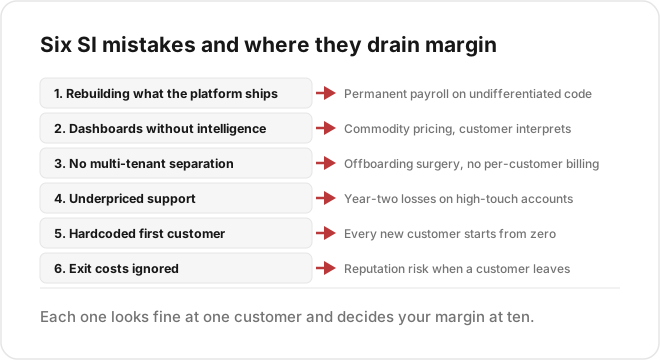
System integrators pick up an IoT platform to move faster, and most of the time it works: connectivity, storage, dashboards, and user management arrive on day one instead of month nine. But speed hides a trap. The same platform that lets you ship a first project in weeks also lets you ship structural mistakes in weeks, and those mistakes compound quietly across every customer you add. The integrators who stall at three or four accounts almost always made one of the errors below early, priced it into nothing, and paid for it monthly.
The six below show up most often, along with what the profitable firms do instead.
Mistake 1: rebuilding what the platform already ships
The most expensive habit is treating the platform as a message broker and rebuilding everything above it: custom portals, custom alerting, custom user management. Every custom layer is code you maintain for the life of the contract, and it turns a product margin into a payroll cost.
Before writing anything, inventory what the platform provides. On TagoIO that includes dashboards, alerts, user and permission management, a device connector library, and a white-label portal layer in TagoRUN. The rule that protects margin: build only what differentiates you, configure everything else. Our guide on build or resell runs the full economics.
Mistake 2: shipping dashboards and calling it a solution
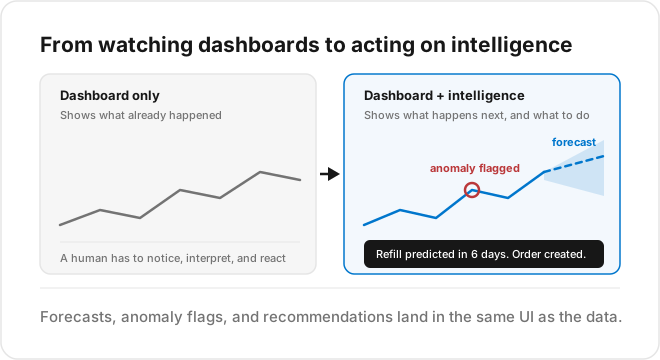
A dashboard shows what already happened. For the customer, that is homework: someone has to open it, notice the drift, interpret it, and react. Integrators who stop at charts end up competing on chart aesthetics, which is a race to the bottom.
The differentiation now sits one layer up, in intelligence. Forecasting when a tank runs empty, flagging the sensor that started drifting before it fails, turning a prediction into a work order. TagoIO’s Analysis scripts and built-in analytics and AI run this logic inside the platform, so a forecast band, an anomaly flag, or a recommendation card lands in the same UI the customer already uses. The customer stops paying you for a picture of their data and starts paying you for decisions they did not have to make.
Mistake 3: one account, many customers
Putting several customers inside a single account with naming conventions instead of real separation feels efficient at two customers and becomes a liability at five: no per-customer permissions, no per-customer billing, and an offboarding that requires surgery.
Multi-tenancy is a day-one decision. Each customer gets their own tenant space, their own users, their own data boundary, and the integrator operates above all of them. That is exactly the structure white-label IoT formalizes, and retrofitting it later costs more than any other correction on this list.
Mistake 4: underpricing support to win the deal
Support is the cost that grows with success. Every deployed device is a future ticket, and a handful of high-touch customers can erase the profit from a dozen quiet ones. Integrators who fold support into a thin monthly fee discover this in year two.
Price support as its own line with severity levels and response times, put the boundaries in writing, and align the whole document with your platform vendor’s commitments. We covered the mechanics in moving from projects to recurring services and how to price an IoT managed service.
Mistake 5: hardcoding one customer’s solution
The first project always works. The mistake is building it so specifically (hardcoded device IDs, one-off scripts, bespoke dashboards) that customer two starts from zero.
The firms that scale treat the first deployment as a template: parameterized analysis scripts, dashboard blueprints, a documented onboarding path. Build once, apply everywhere. That single discipline is what separates a project shop from a product business, and it is what makes the managed service model profitable.
Mistake 6: ignoring exit costs until exit
Data export, device migration paths, and contract ownership rarely get read before signing. Then a customer asks to leave, or you need to switch vendors, and the answer decides whether you keep your reputation.
Check for documented export APIs in standard formats and read the fine print on who owns the customer relationship. Our vendor lock-in guide lists the questions worth asking while you can still negotiate.
The pattern behind all six
Every mistake here is the same mistake wearing different clothes: optimizing for the first deal instead of the tenth. The platform choice, the tenant structure, the pricing, the intelligence layer, all of it looks fine at one customer and decides your margin at ten.
If you are evaluating platforms with the tenth customer in mind, start with the buyer’s guide, then look at how TagoIO handles multi-tenancy, white-label, and built-in analytics and AI. Book a demo or start free.