
I have spent more than 25 years around industrial machines: writing firmware, designing hardware, debugging connectivity in places that had none. For most of that time the rules were stable. You built a better machine than your competitor, priced it fairly, and won. The engineers I grew up with mastered those rules. Many of them run traditional companies today.
Somewhere in the last decade the rules changed, quietly enough that plenty of good companies missed it. I remember the first time I saw it up close. A manufacturer I knew had the best product in its category by every measure that used to matter: precision and build quality. It lost a major contract to a competitor whose machine was worse. The competitor’s machine reported everything it did, every hour, from every site. The buyer was no longer comparing machines. The buyer was comparing what it could learn from them.
The squeeze on traditional companies
Traditional companies are squeezed from two sides. Hardware makers that never fuse their products with data get commoditized, and their machines become interchangeable boxes competing only on price. Meanwhile the software giants circling their markets lack the domain physics: the engineering knowledge that decades of building real products bakes into a company. A hardware maker that adds data has a moat software alone cannot cross. I have watched both halves of that squeeze play out, in company after company. The need is not another dashboard. The need is a path from selling machines to selling what the machines know.
The clearest map of that path I have found is Fusion Strategy: How Real-Time Data and AI Will Power the Industrial Future (Harvard Business Review Press, 2024), by Vijay Govindarajan and Venkat Venkatraman. Their argument is direct: industrial companies win the next era not by making better machines, but by fusing physical products with real-time data, creating businesses that pure software companies cannot copy. It matched what I had been seeing in the field for years.
Your product already has a datagraph
Google has a search graph. Meta has a social graph. Govindarajan and Venkatraman argue that every industrial company can build its own version: a datagraph, the living map of how a company’s products actually perform in the real world, across thousands of customers, every day.
John Deere is the book’s flagship example. Its See & Spray system puts cameras and AI on the sprayer, so the machine tells weeds from crops in real time and sprays only the weeds. Farmers cut their herbicide use sharply, the machine pays for itself in saved chemicals, and Deere can price the value delivered per acre instead of selling a tractor and walking away. The business model itself changed.
The machine is no longer the product. The machine is the sensor, the datagraph is the asset, and the outcome is the product.
Whoever owns and learns from that data sets the terms of the industry. The machine is how you collect it.
The four steps of fusion
The authors describe a climb every hardware company can attempt. Each rung changes what the company sells and how much of its value comes from data. I have met companies on every one of these rungs.
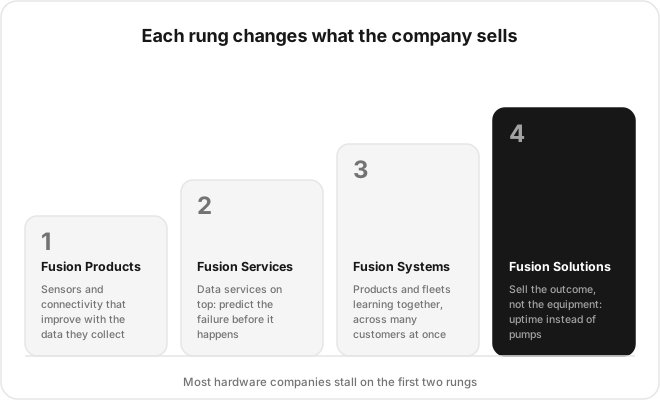
The ladder above is adapted from Fusion Strategy (Govindarajan and Venkatraman, 2024).
Fusion Products are machines with sensors and connectivity that improve with the data they collect. This is where most companies I meet stand today. Often they added connectivity because a customer’s RFP demanded it, and the data now lands in a database nobody opens.
Fusion Services attach data-driven offerings to the product, like predicting a failure before it happens. One equipment maker we work with started with a single alert: tell the customer when a compressor drifts out of its normal vibration profile. That alert grew into a paid monitoring plan, and the plan now renews better than the hardware warranty ever did. It is one of the revenue streams most manufacturers miss.
Fusion Systems connect products and fleets so they learn from data across many customers. A cold-chain operator sees one truck. A fusion system sees every truck on every route, and starts answering questions no single customer could ask alone.
Fusion Solutions sit at the top of the ladder: selling the outcome the data enables rather than the equipment. Uptime instead of pumps. A verified cold chain instead of temperature loggers.
Most hardware companies stall on the first two rungs. In my experience the block is rarely ambition. It is infrastructure: collecting the data reliably at fleet scale, and turning it into something a customer will pay for. That work is unglamorous, and it decides who climbs.
What I tell traditional companies
At TagoIO we work with hardware manufacturers in more than 130 countries, and I have some version of this conversation every week. The advice has not changed much in years.
Start smaller than feels comfortable. Pick one product line and one question the data could answer for your customer, then ship that. The datagraph grows from use, and the first answer a customer pays for teaches you more than a two-year platform project.
Respect the asset you already own. Your domain knowledge is the moat. A software startup can rent cloud servers in an afternoon; it cannot rent thirty years of knowing how your machines behave in a Brazilian summer or a Canadian winter. Fusion works because the physics and the data belong to the same company: yours.
And do not confuse the plumbing with the point. Collecting, storing, and moving device data is a solved problem; platforms like ours exist for exactly that. The unsolved problem, the one only you can work on, is deciding what your company sells at the top of the ladder.
Where AI fits, and what I do not know yet
AI raises the ceiling of every rung on this ladder. Failure prediction that used to need a data science team now ships as a feature. Fleet data that sat unread can be questioned in plain language. We build for this every day in TagoIO’s AI area, and I expect AI to help traditional companies climb faster than anything I have seen in my career.
I also want to name a challenge I have not solved: scale in narrow niches. A model trained across thousands of tractors gets smart quickly. A niche with a few hundred specialized machines in the field creates real value for its customers, yet may never produce the data volume that makes the economics of AI obvious. How those niches scale their datagraphs is a question I sit with every week. I do not have the answer yet, and I am cautious with anyone who claims they do.
The window is open, for now
Govindarajan and Venkatraman close with a point every leader of a traditional company should sit with: this transformation cannot be delegated. The climb changes what the company sells, and only the chief executive can change that. In my decades in this industry, every stalled data initiative I have seen was sponsored two levels too low.
Some company in your industry will build its datagraph first and set the terms for everyone else. After years of watching excellent machines lose to learning machines, I no longer open conversations by asking executives whether their product beats the competitor’s. I ask the question this book taught me to ask: what is your product’s datagraph?
The answer, drawn
It is a fair question to turn back on me, so I will close by drawing two answers. The first comes straight from the book. Deere’s datagraph is not the sprayer; it is what accumulates behind the fleet.
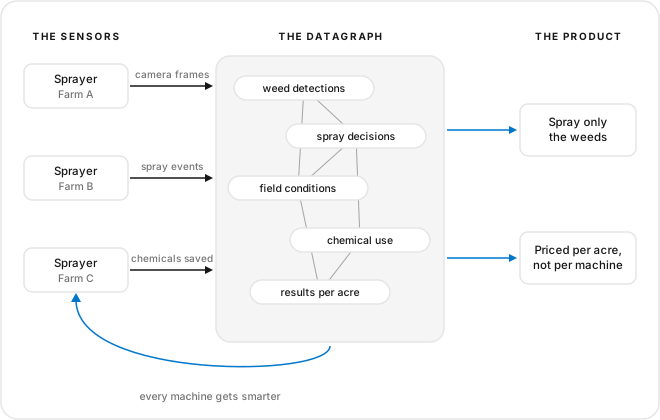
Each farm feeds the same graph, and the graph makes every sprayer smarter than any single farm could.
The second is a product I meet every week: the industrial compressor. No single plant can build this graph. The manufacturer can, because it sees every unit it ever shipped. The same drawing works for leak detection in buildings, water meters, or any machine that lives far from its maker.
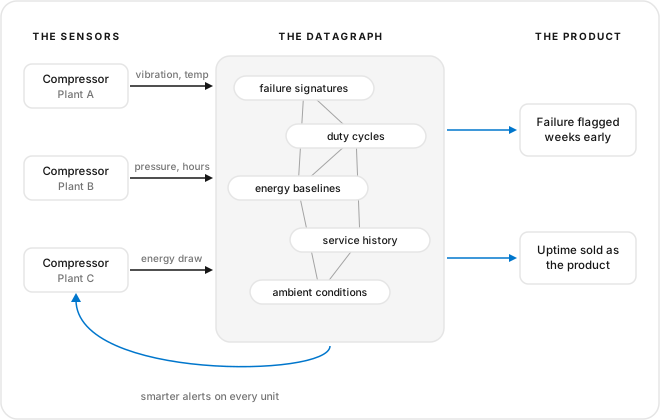
A single compressor streaming vibration is a chart. Thousands of compressors across many plants become failure signatures and baselines only the manufacturer can build.
Draw this for your own product. The left column is what you already sell. The right column is what your customers actually want to buy. The middle column is where the next decade of your company lives.