
Open source IoT platforms are genuinely good, and that surprises people who expect a sales pitch to say otherwise. ThingsBoard, ChirpStack, and Node-RED are mature, widely deployed, and free to license, and for the right team they are the right choice. But “free to license” and “free to run” are different sentences, and the distance between them is where most open source IoT decisions go wrong. The honest comparison is not license fee versus subscription. It is who operates the platform, who secures it, and who builds the layers the license does not include.
What open source actually includes
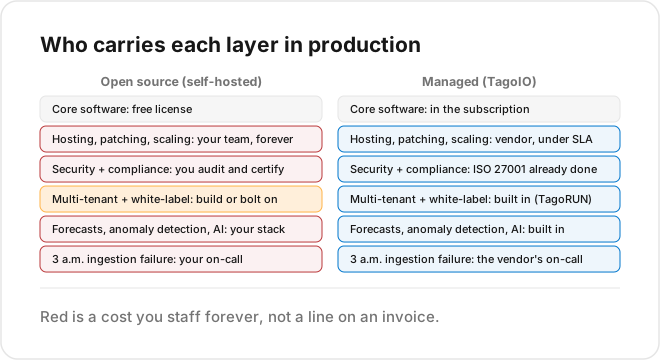
The download gives you the software: device connectivity, data storage, dashboards, and in the stronger projects a rules engine. What it deliberately does not include is the running of it. Hosting, TLS certificates, backups, version upgrades, security patches, scaling the database when the fleet grows, and the 3 a.m. response when ingestion stops: all of it belongs to your team from day one.
None of that is hidden. It is the deal. The question is whether your organization wants to be in the platform operations business, because that is a payroll decision, not a licensing one. A realistic self-hosted deployment carries a fraction of an engineer permanently, more during upgrades and incidents, and that cost recurs forever, exactly like the subscription it replaced.
What managed actually includes
A managed platform sells you the operations you would otherwise staff: uptime backed by an SLA, security patching, certified compliance (TagoIO is ISO 27001 certified), scaling that happens without a migration project, and support with response times. The subscription is the visible cost; the invisible benefit is the engineering roadmap you did not spend on infrastructure.
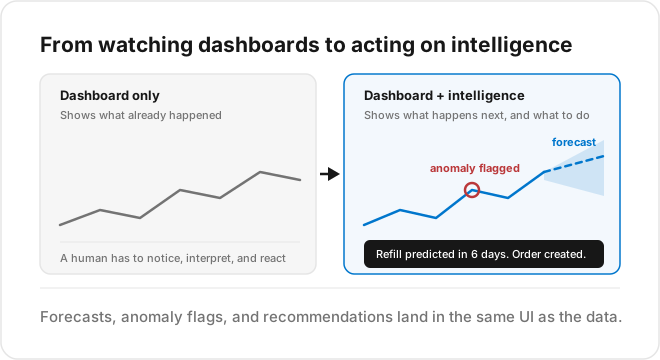
The second difference is less discussed: the application layers above storage. Multi-tenant customer separation, white-label portals, user management with granular permissions, and increasingly the intelligence layer. On TagoIO, analytics and AI are part of the product: forecasting, anomaly detection, and AI-assisted analysis run inside the platform and surface in the same UI as the live data, so a chart carries its forecast band and a drifting sensor gets flagged without anyone building a data science pipeline first. Reproducing that on open source means assembling and maintaining your own stack, model hosting, retraining, and UI integration included. It is doable, and it is a project with headcount attached.
Where open source wins
Be honest about the cases where self-hosting is right. Full data sovereignty requirements with no acceptable cloud region. Air-gapped or on-premises industrial environments. Teams whose product is the platform itself, where operating it is the differentiation. Heavy customization at the protocol level. Zero-budget experimentation and learning. And any scenario where you already employ the platform team anyway.
There is also a hybrid worth knowing: TagoCore is TagoIO’s open source edge component, which runs on-premises hardware and forwards to the cloud platform, covering many sovereignty and edge cases without taking on the whole operations burden.
Where managed wins
Managed wins when the platform is a means rather than the product: when your differentiation is the vertical solution, the hardware, or the customer relationship, and every hour spent on database upgrades is an hour taken from that. It wins on time-to-market, on compliance paperwork someone else has already done, on the analytics layer arriving built, and on the arithmetic that a fraction of a permanent engineer usually costs more than the subscription it would replace.
This is the same build-versus-buy logic we ran for AWS IoT Core versus a managed platform, and it lands the same way for most teams: the ones who should self-host already know they should.
The three-year comparison
Model both options over three years, not one: subscription on one side; hosting, the operations fraction of an engineer, upgrade projects, security reviews, and the analytics build on the other. Include exit costs in both directions, because avoiding lock-in matters with a vendor and with your own accumulated custom code alike. Our three-year pricing guide has the full framework.
The decision is rarely about software quality. Open source and managed platforms can both be excellent. The decision is about which business you want to be in: operating infrastructure, or shipping what runs on it.
If the second one sounds like you, TagoIO is a managed platform you can evaluate in an afternoon. Book a demo or start free.