
Predictive analytics is one of those phrases that shows up in every IoT pitch and rarely gets defined. It sounds like a product you buy or a team you hire. In practice it is something narrower and more useful: using the data you already collect to say something specific about what happens next, so a decision can be made with lead time instead of hindsight.
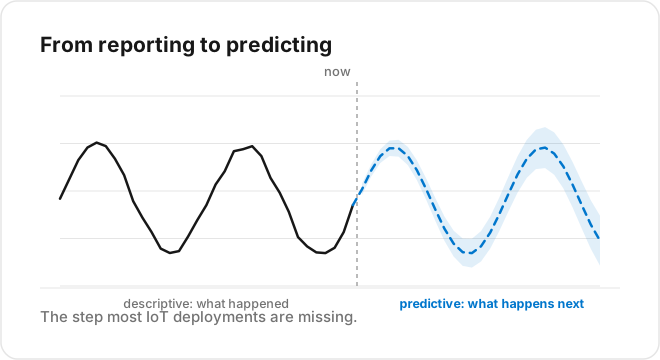
Most IoT platforms are very good at descriptive analytics, showing what happened and what is happening. That is where value stalls for a lot of deployments. The dashboards are live, the alerts fire, and the operation still runs reactively because nothing on the screen looks forward. Predictive analytics is the step that closes that gap, and getting started matters more than getting it perfect. This is a plain guide to what it is and how to ship your first one.
The three kinds of analytics, briefly
It helps to place predictive analytics against its neighbors. Descriptive analytics tells you what happened: yesterday’s peak, this shift’s average. Predictive analytics tells you what is likely to happen: the load this afternoon, the runout date, the component trending toward failure. Prescriptive analytics goes one step further and recommends or takes an action: shed this load, order this part now.
Most teams have descriptive analytics already. Predictive is the achievable next step, and it is the one that changes how the operation runs, because a forecast is what lets you act before a problem instead of after.
Where it pays off in IoT
Predictive analytics earns its cost wherever acting early beats acting late, and IoT is full of those. Predictive maintenance spots a machine trending toward failure so you service it on a schedule instead of after a breakdown. Demand and consumption forecasting positions stock and plans production ahead of need. Depletion forecasting triggers refills before a tank runs dry. Energy forecasting avoids the peak that sets a demand charge. Predictive alerting warns of a threshold breach while there is still time to prevent it.
The common thread is lead time. If knowing something a few hours or days ahead would change what you do, that is a candidate for predictive analytics. If it would not change anything, skip it, because a forecast nobody acts on is a chart, not a capability.
The honest requirements
Predictive analytics has real prerequisites, and pretending otherwise is why projects disappoint. You need history that covers the pattern you want to predict, weeks for a daily cycle, longer for seasonal ones. You need data that is reasonably clean and consistent, because a model trained on gaps and glitches learns gaps and glitches. You need a decision the forecast will actually feed, named before you build. And you need to score the forecast continuously, because an unmeasured model quietly rots and takes your trust with it.
None of these require a data science org. They require picking a signal with enough history, a decision worth informing, and the discipline to measure whether the forecast is any good.
Where teams go wrong
The usual mistakes are predictable. Starting with the most advanced model instead of the simplest one that works, and losing a quarter to it. Building a forecast with no decision attached, so it becomes a dashboard nobody uses. Shipping a model and never scoring it, so it degrades unnoticed. And trying to predict everything at once instead of proving the loop on one signal. Avoiding these is most of the battle.
Your first predictive project
Start small and concrete. Pick one signal where seeing a few hours or days ahead would change a real decision, a tank that must not run dry, a peak that costs money, a machine whose failure is expensive. Build the simplest forecast that could work, often a seasonal baseline, in a scheduled script that reads recent data and writes a prediction back. Plot it against actuals so you can see how it does. Score the error on a schedule. Then wire the prediction to the one decision, an alert, a reorder, a work order.
That single loop, running live and measured, teaches you more than any planning, and it is the template every later predictive project reuses.
Because TagoIO Analytics produces forecasts against your live data, the whole loop, read, forecast, score, act, lives on the platform you already use. Predictive analytics for IoT is not a product you switch on. It is a habit you start with one signal, and see how TagoIO Analytics runs it.
You can start without writing any code. Sign in to TagoIO Analytics at sight.tago.io/login with your TagoIO account, pick one signal, and train a model in minutes. It gives you forecasts and anomaly detection on your own data, so you do not need to be a data scientist to get real results.