
Once you decide to forecast an IoT signal, the internet hands you a wall of options: ARIMA, exponential smoothing, Prophet, XGBoost, LSTM, transformers. Every one has a paper claiming it is the best. Most of that debate is written for Kaggle competitions, not for a fleet of sensors reporting every few minutes for years.
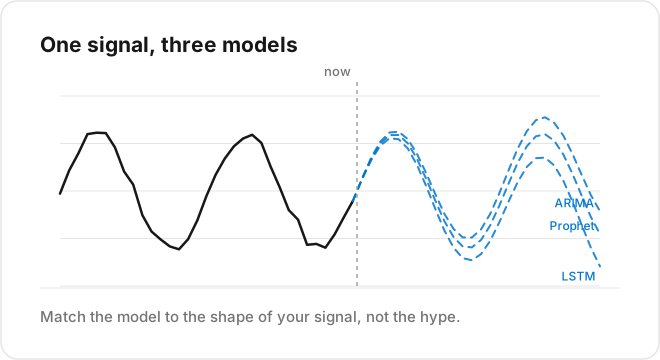
The choice that matters for IoT is not “which model wins a benchmark.” It is “which model matches the shape of my signal and the size of my team.” Pick wrong and you either ship a model too weak to trust or spend a quarter maintaining one you did not need. Here is how the main options actually differ, and how to choose without a research budget.
ARIMA: the statistical baseline
ARIMA models a signal from its own past values and past errors. It is strong when your data is stationary or can be made stationary, meaning its statistical behavior does not wander over time, and when the pattern is driven by recent history rather than outside factors.
For a single sensor with a stable pattern and no strong seasonality, ARIMA is accurate and cheap. The problem is that real IoT signals are rarely that polite. They have daily and weekly cycles, they drift as equipment ages, and they respond to weather and usage. Classic ARIMA needs manual tuning to handle seasonality, and that tuning does not transfer well from one device to the next. On a fleet, per-device hand-tuning does not scale.
Prophet: seasonality without a statistics degree
Prophet, from Meta, was built for exactly the signals ARIMA finds awkward: strong daily, weekly, and yearly cycles, holidays, and missing data. It decomposes a series into trend plus seasonal components and returns a forecast with a confidence range, with sensible defaults that a non-specialist can run.
For most IoT monitoring, energy load, water demand, occupancy, foot traffic, Prophet is the pragmatic default. It handles the seasonality that dominates these signals, tolerates gaps, and does not need a stationary series. The trade-off is that it treats the signal as a sum of smooth patterns, so it is weaker when the future depends on other live inputs, like production rate or outside temperature, interacting in complex ways.
LSTM and gradient boosting: for signals with many drivers
When the value you want to predict depends on several changing inputs at once, and on the interactions between them, you have left the territory where decomposition works. This is where machine learning models earn their place. Gradient-boosted trees (XGBoost, LightGBM) handle multi-input forecasting well and train fast. An LSTM, a neural network built for sequences, can capture long, nonlinear time dependencies.
The cost is real. These models need more training data, a feature pipeline, an honest evaluation split, and retraining as conditions drift. An LSTM in particular is easy to get wrong and hard to debug. The rule of thumb: use them when a Prophet-style model has measurably failed on your signal, not because a neural network sounds more advanced.
A decision you can make in an afternoon
Look at one week of your signal plotted. If it is a stable wiggle with no clear cycle, start with ARIMA or simple exponential smoothing. If it has obvious daily or weekly rhythm, which most IoT signals do, start with Prophet. If the value clearly rides on other measured inputs, and the simpler model has already let you down, move to gradient boosting or an LSTM.
Whichever you pick, the harness matters more than the algorithm: split your history, forecast the held-out part, score the error, and rerun that check on a schedule so you catch drift.
Running it on TagoIO
The winner has to live next to your data. TagoIO Analytics produces the forecast on a schedule right where your telemetry lands, reads a device bucket, and writes the prediction back as a variable your dashboards and alerts consume. The model choice becomes a setting you can change, not a platform you have to migrate.
Start with the simplest model your signal’s shape allows, prove it against held-out data, and only climb the ladder when the numbers tell you to. See how TagoIO Analytics runs the model behind your forecasts.
If you would rather not pick and tune a model at all, TagoIO Analytics does it with no code. Sign in at sight.tago.io/login with your TagoIO account and train a forecast on your data in minutes, anomaly detection included, without a modeling script or a data scientist.