
IoT data ownership feels like a settled question right up until you try to leave a platform, fail an audit, or get asked by a European customer where their data physically sits. Then you discover that “your data” was doing a lot of quiet work in the contract, and the answer to who controls it was not the one you assumed.
Most teams never ask these questions during selection, because the platform is being evaluated on features and price and the data governance section reads like boilerplate. But ownership, residency, and compliance are not boilerplate. They decide whether you can exit, whether you can sell into regulated markets, and whether an audit is a formality or a fire drill.
There are really three separate questions hiding under “data ownership,” and they get answered by three different parts of a vendor relationship. Here is how to pull them apart and what to ask.
Question one: who owns the data
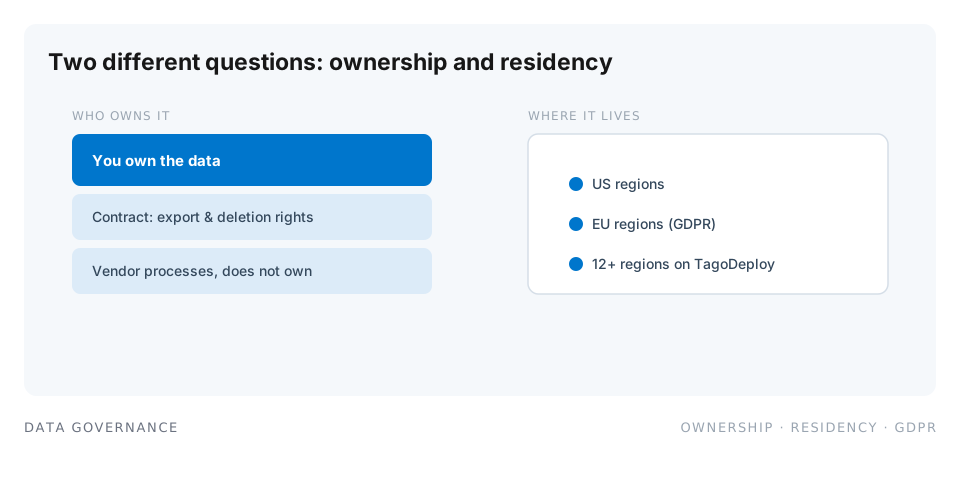
Ownership is a contract question, not a technical one, and the words matter. You want the agreement to state plainly that you own your data and the vendor is a processor that stores and handles it on your behalf, not an owner or co-owner of it.
The practical tests of real ownership are export and deletion. Can you get all of your data out, in a usable format, whenever you want, without a fee that makes leaving painful? And can you have it deleted on request and get confirmation? If either is gated, restricted, or vague, you do not fully own the data no matter what the headline says. TagoIO’s position here is simple: your data is yours, reachable any time through the API, which means export is a routine call, not a negotiation.
Ask the blunt version during selection: “If we leave in two years, how do we get everything out, and what does that cost.” The quality of the answer tells you who really owns the data.
Question two: where the data lives
Residency is a separate question from ownership, and confusing the two causes real problems. You can own your data completely and still have it stored in a region that breaks a customer contract or a regulation. Residency is about the physical and legal location of the data, and for a growing number of deals it is a hard requirement, not a preference.
The reasons are concrete. A European customer may require their data to stay in the EU. A public-sector or healthcare client may mandate a specific jurisdiction. A data sovereignty law may forbid the data leaving the country. If your platform stores everything in one region with no choice, you cannot serve those customers, full stop.
This is where deployment model matters. TagoIO’s shared instances cloud runs in major regions, and for stricter requirements, TagoDeploy provides dedicated deployments in 12 or more regions on AWS, so the data can live where the contract or the law requires. The question to ask any vendor: “Which regions can our data be stored in, and can we choose.” If the answer is “one,” that is a ceiling on your addressable market.
Question three: what GDPR actually requires
GDPR is where ownership and residency meet regulation, and it is more specific than “keep data in Europe.” Evaluating a platform for GDPR readiness comes down to a few checkable things rather than a vibe.
Look for a Data Processing Agreement the vendor will sign, which defines them as your processor and sets out their obligations. Look for support of data subject rights: the ability to export, correct, and delete personal data on request, which ties directly back to the ownership tests above. Look for security controls appropriate to the data, encryption in transit and at rest and real access control. And look for an independent security certification as evidence the controls are real, not claimed. TagoIO is ISO 27001 certified and GDPR-ready, which means a customer’s compliance team is reviewing an audited program rather than taking your word for it.
The mistake teams make is treating GDPR as a legal checkbox at the end. It is a platform selection criterion, because if the platform cannot support data subject rights and residency, no contract clause can bolt them on afterward.
Bring it together before you sign
These three questions are cheap to ask during selection and expensive to discover after. Ownership is settled in the contract, and the export and deletion tests prove it. Residency is settled by the platform’s regional options, and it decides which customers you can serve. GDPR readiness is settled by a signed DPA, support for data subject rights, and an independent certification, and it decides whether regulated markets are open to you.
Ask all three before you commit, not during your first audit. If you are drawing up a vendor shortlist, the companion checklist in the key questions to ask before choosing an IoT platform folds these into the wider evaluation, and how to choose between AWS IoT Core and a managed platform covers where the compliance burden lands in each model.
Your data should be yours, stored where you need it, handled in a way you can prove. Make the vendor demonstrate all three. Want to see how TagoIO handles ownership, residency, and GDPR? Book a demo or start free.