
Every IoT platform has a partners page now. The logos rotate, the tiers have metal names, and the application form takes ten minutes. But “partner program” covers everything from a genuine wholesale business model to a badge and a discount code, and the parts that decide whether an integrator makes money are exactly the parts the page rarely spells out.
The honest answer to which program is best is that it depends on what your practice sells. So the useful move is to know what a real program contains, and which questions expose the difference before anything is signed.
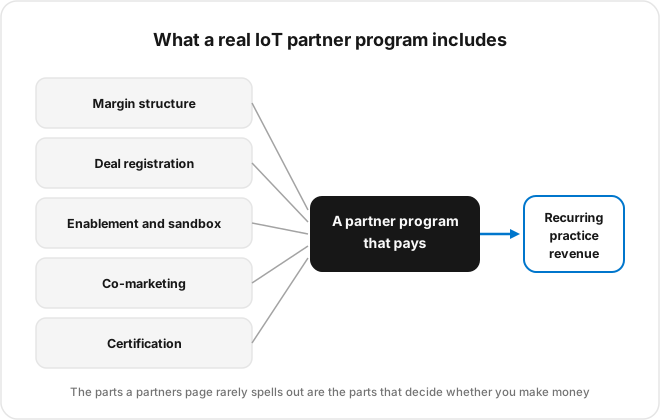
What a real partner program includes
Margin structure comes first because it is the business model. Programs pay partners three different ways, and how reseller programs and margins work breaks down the mechanics and the realistic ranges for each. The short version for this discussion: the margin type matters more than the margin percentage. A discount you can never raise is worth less than a wholesale rate under pricing you control, because in the second case you own the retail price and the invoice, and the difference compounds every year the customer renews.
Deal registration protects the work you do before the sale. A registered opportunity should shield you from other partners and, more importantly, from the vendor’s own direct sales team. A program without written deal registration is a program where your best prospect can become the vendor’s house account, and the three months of pre-sales work you invested become a strongly worded email.
Technical enablement and sandbox access separate programs built for integrators from programs built for logos. You need a development environment that costs nothing or close to it, training your engineers can finish in days rather than months, and access to real solution architects when a deal gets technical. If you cannot build a production-shaped proof of concept before paying, the program is marketing.
Co-marketing ranges from a directory listing to funded case studies and shared leads. It is the least predictable component and deserves the least weight in your decision, but a vendor that funds a case study is signaling that it wants your vertical.
Certification cuts both ways. A credential can shorten sales cycles when buyers recognize it, and hyperscaler badges often do. It can also be a revenue product the vendor sells to its own channel. Weigh the hours and fees against what the badge actually closes.
Reading the margin before you sign
Vendors rarely publish partner margins, which makes the market harder to read than it should be. The ranges are stable enough to plan around once you have seen a few agreements, and they are set out with the caveats in how reseller programs and margins work rather than repeated here, because two different numbers on the same site help nobody.
What that post will not tell you is how the number behaves over time. Ask what the margin looks like in year three, after the introductory tier expires, and check the underlying platform pricing model while you are there: a partner margin sitting on top of consumption pricing you cannot predict is not a margin you can quote to a customer with confidence.
The programs you will actually compare
AWS and Microsoft run the largest partner networks in software, and their IoT services inherit that machinery: deep enablement, certifications buyers recognize, and marketplaces, in exchange for programs designed around consumption of their clouds. Specialist platforms such as Losant, Particle, Blynk, and ThingsBoard run smaller programs shaped around their own models, from hardware-plus-connectivity bundles to open-source support plans.
Any of them can be the right answer for a given practice. The deciding variable is not the size of the network but the fit between the program’s economics and how your business intends to bill. That is a different question from which platform is technically strongest to build on, which is covered in the platforms integrators actually resell.
Questions to ask before joining
Ask who owns the customer relationship and the billing, in writing. That single answer shapes your whole downstream contract, including the SLA you can offer, since you cannot commit to something the vendor has not committed to you.
Ask what happens when the vendor’s direct team finds your registered prospect. Find out whether the sandbox tier can hold a production-shaped pilot or only a demo. Check how many partners already work your region and vertical, because a saturated program is a referral queue with a logo. And ask what happens to your customers if you ever leave the program, because the answer tells you who the vendor believes the customer belongs to.
How TagoIO approaches it
TagoIO’s program, at tago.io/partners, is built around the wholesale model described above. Partners deploy on the platform, white-label the customer-facing side through TagoRUN, and set their own retail pricing over published per-device rates. The free tier works as a real sandbox, so the proof of concept happens before any commitment, and there is no certification fee standing between an engineer and a running solution. There is a walkthrough of how system integrators build on TagoIO if you want to see the delivery side.
It is a program shaped for integrators who want to own the customer and the margin, which is the same choice that sits at the center of the build or resell decision and of what a profitable managed service model looks like.
The best partner program is the one whose economics match the business you are building. Read the terms the way you would read a customer contract, because that is what it is.
Evaluating platforms for your practice? Talk to us or start free.