
Most “best IoT platform” lists are written for the company that will run the platform. Almost none are written for you, the system integrator who has to resell it, put your name on it, support it at 2 a.m., and still make a margin. That is a different question, and it deserves a different answer.
A platform that is a joy to prototype on can be a nightmare to resell. What matters when you resell is not the feature checklist. It is whether you can brand it, price it, support it, and grow it across many clients without rebuilding your business every time you add one.
So this guide judges platforms the way a reseller should: by the economics and the operational load, not the demo. We will name real options across the three honest categories, say what each is good and bad at, and be clear about where TagoIO fits and where it does not.
First, decide what “reselling” means for you
There are three routes to putting an IoT offering in front of your clients, and they are not the same business.
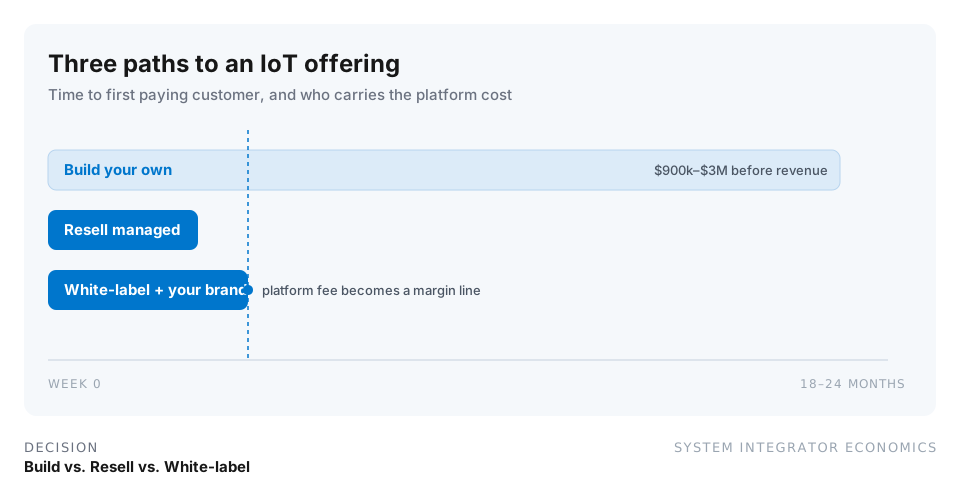
Build your own on raw cloud. You own everything and you differentiate on the platform itself. You also spend 18 to 24 months and a large budget before your first client pays you, and the maintenance never stops. We walked through that math in the three-year economics of building versus reselling. For most integrators, the platform is not the product. The solution that runs on it is.
Resell a managed platform as-is. You sell licenses or seats, add your integration and support work on top, and keep the vendor’s brand visible. Fast to start, lower margin control, and your client knows whose logo is on the login screen.
White-label a managed platform. You put your brand on the portal and apps, sell it to your clients as your product, and the platform fee becomes an input cost to a recurring revenue line rather than a sticker your client sees. This is the route that turns a platform from a cost into a margin. We made the full case in build or resell, the question every system integrator gets wrong.
Once you know which of these you are doing, the platform shortlist gets much shorter.
How to judge a platform you intend to resell
Before the names, here is the scorecard. Run every candidate through these six questions.
Can you white-label it cleanly? Not just a logo swap. Can your client log into a portal and mobile app with your brand, your domain, and no mention of the underlying vendor? If white-labeling is an enterprise-tier afterthought, your margin story is weak.
Is the pricing predictable as you scale? You are going to quote fixed monthly prices to clients. If the platform bills you by data volume or by event in ways you cannot forecast, you carry the risk. Per-device or per-tenant pricing is far easier to build a service around. We covered this trap in comparing IoT platform pricing over a three-year horizon.
How much of the platform runs itself? Every hour you spend patching the platform is an hour you are not billing for solution work. Managed beats self-hosted here unless infrastructure control is genuinely your differentiator.
Can one layout serve many clients? Multi-tenancy and template-driven dashboards decide whether client number fifty costs the same to onboard as client number five. This is the single biggest lever on reseller profitability.
What is the support surface? When a client calls, can you resolve it, or are you a ticket relay to the vendor? A platform with a real API, good docs, and observability lets you own the support relationship.
Is compliance handled for you? If the platform is already ISO 27001 certified and GDPR-ready, you inherit that in your sales conversations instead of building it. For regulated clients, this closes deals.
The honest shortlist
No single platform wins every category. Here is where the real options land for a reseller.
Open-source engines (ThingsBoard, TagoCore, Node-RED-based stacks). The appeal is obvious: no license fee and full control. ThingsBoard Community Edition bundles device management, dashboards, and rule chains in one place, and it is genuinely capable. The catch for a reseller is that “free” moves the cost from a license line to your engineering payroll. You host it, scale it, secure it, patch it, and carry the compliance burden yourself. Open source is a strong choice when infrastructure control is your actual product. It is a weak choice when you want to resell an outcome and move on. TagoIO’s own open-source engine, TagoCore, fits the edge and self-host case rather than the multi-tenant reseller case, and we are candid about that.
Hyperscaler building blocks (AWS IoT Core, Azure IoT Hub). These are infrastructure, not a finished product. They scale to billions of devices and integrate with the rest of the cloud, which matters if your client already runs in that cloud. But there is no application layer out of the box: no multi-tenant portal, no dashboard engine your client can use, no mobile app. You build that. For a reseller, that is the build route wearing a resell costume. We compared this trade-off directly in how to choose between AWS IoT Core and a managed IoT platform.
Managed application platforms (TagoIO, and peers like Cumulocity or ThingsBoard Cloud). This is the category built for the resell and white-label routes. The platform ships the application layer as the product: dashboards, multi-tenant separation, user and permission management, alerting, and mobile-ready portals on day one. You add vertical expertise and keep the recurring margin.
This is where TagoIO is a strong fit, and we will say why plainly rather than pretend it wins on every axis. TagoIO is built around tags and an API-first model, so provisioning and organizing a large fleet across many clients is routine. TagoRUN gives you a white-label browser and mobile portal so your client sees your brand, not ours. Blueprint dashboards let you build one layout and apply it to every client automatically, which is the multi-tenant advantage that makes reseller economics work. And the platform is ISO 27001 certified and GDPR-ready, so you inherit that in regulated deals. Where TagoIO is not the answer: if you need to own the infrastructure layer itself, or your differentiation is a custom protocol stack, a hyperscaler build will serve you better.
Match the platform to the route, then the client
Put the two halves together and the decision is almost mechanical.
If you are building infrastructure as your product, resell nothing; build on a hyperscaler. If you want full control and have the engineering bench to run it, self-host an open-source engine. If you want to sell an outcome under your own brand and keep the recurring margin, white-label a managed application platform. That last route is where most integrators actually make money, and it is the one the market underserves with honest advice.
We wrote the companion pieces to this decision so you can go deeper on the parts that matter to your business: how IoT reseller programs and margins actually work, how to differentiate your IoT managed service, and the real-world view in how system integrators build IoT solutions with TagoIO. If you want to see the reseller model in production, the simplifying IoT deployments use case shows an integrator scaling from custom builds to a repeatable offering.
The best platform to resell is not the one with the longest feature list. It is the one you can brand, price, support, and scale without rebuilding your business for every new client. Judge on that, and the shortlist writes itself.
Want to test the white-label route with your own clients? Start free on TagoIO or book a demo and we will walk through the reseller setup with you.