
If you sell an IoT managed service, you already know the uncomfortable moment: the prospect asks why they should pick you over the integrator down the road, and the honest answer is that your offerings look nearly identical. Same sensors, same dashboards, same monthly fee. When buyers cannot see a difference, they buy on price, and price is a race you do not want to win.
The instinct is to fix this by adding features. More widgets, more integrations, more dashboard types. But features are the easiest thing for a competitor to copy, and most of them come from the platform anyway, which means your competitor running the same platform has them too. Competing on features is competing on someone else’s roadmap.
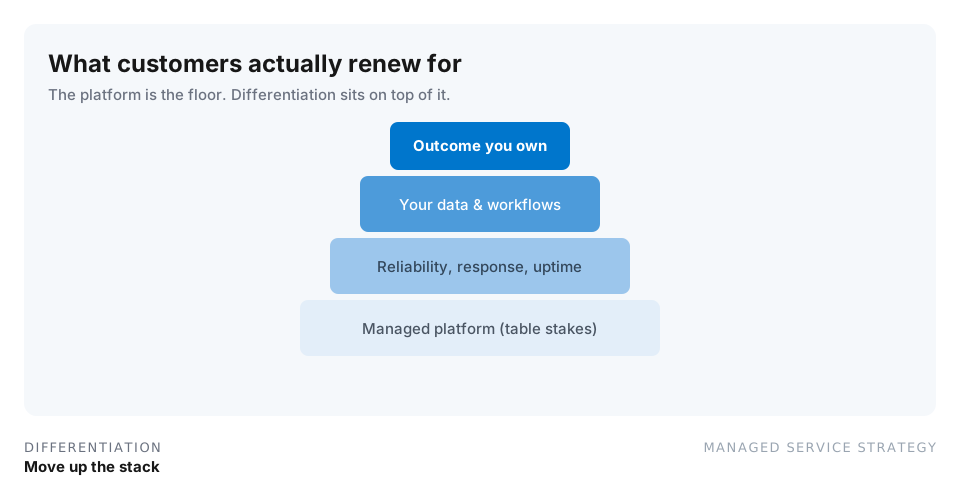
Real differentiation comes from the layers a competitor cannot copy from a pricing page: the outcomes you guarantee, the vertical you know cold, and the data relationship you own with the client. Here is how to build on each.
Stop selling the platform, start selling the outcome
Your client does not want a dashboard. They want spoilage under two percent, or unplanned downtime cut in half, or an audit they pass without scrambling. The platform is how you deliver that, not what you sell.
The shift sounds simple and is hard in practice: write your proposals and your SLAs around the result, not the tooling. Instead of “real-time temperature monitoring with alerts,” sell “we keep your cold chain inside spec and prove it for your auditor, or we make it right.” That reframing does two things. It makes you hard to compare on a spec grid, and it moves the conversation to value, which is where your margin lives. We made the pricing version of this argument in how to price an IoT managed service: tie the price to the outcome, not your cost.
Outcome selling only works if you can actually deliver and prove the outcome. That is where the platform earns its place, quietly, underneath. TagoIO Actions turn thresholds into guaranteed responses, and Analysis scripts turn raw readings into the metric your client actually cares about. The client never sees any of it. They see the outcome.
Go deep in one vertical instead of wide across ten
A generalist integrator who can “do IoT for anyone” is easy to replace. A specialist who understands cold chain compliance for pharmaceutical distribution, or OEE for a specific class of machine, is not. Vertical depth is the differentiation that compounds, because every deployment teaches you something the generalist never learns.
Concretely, that means building your own templates, your own alert logic, and your own reports for one vertical, then reusing them across every client in it. This is also where the platform economics reinforce the strategy. With Blueprint dashboards, you build the vertical’s ideal layout once and apply it to every client automatically, so your specialization scales instead of eating your delivery time. The logistics-specific playbook in 10 TagoIO features for IoT in logistics is a good example of how far one vertical can be pushed.
The counterintuitive part: narrowing your focus widens your margin. The narrower your vertical, the fewer credible competitors, and the more your accumulated expertise is worth.
Own the data relationship and the brand
When your client logs into a portal with your name on it, sees reports you designed, and comes to you to ask what the data means, you are not a reseller they can swap out. You are embedded in how they run their operation. That is the stickiest form of differentiation there is, and it is almost entirely about who owns the relationship, not who owns the technology.
White-labeling is the mechanism. With TagoRUN, your clients use a browser and mobile portal branded as your product, so every interaction reinforces your brand rather than the platform vendor’s. And increasingly, the data relationship itself is a differentiator: with the TagoIO MCP server, you can offer clients natural-language answers from their own IoT data, a service most integrators cannot yet deliver. We covered that emerging edge in querying IoT data in natural language.
Put it together
Differentiation is not a feature you add. It is a position you build, on three layers a competitor cannot lift from a pricing sheet: the outcomes you stand behind, the vertical you know better than anyone, and the branded data relationship you own with the client. The platform’s job is to make all three cheap to deliver and impossible for the client to see. That is exactly the job a managed application platform is built for, which is why the platform choice and the differentiation strategy are the same decision viewed from two angles. We connected those angles in the best IoT platforms for system integrators to resell and how IoT reseller programs and margins work.
Pick one vertical, rewrite one proposal around the outcome, and put your brand on the portal. That is a differentiated managed service, and it renews.
Want to build it on a platform designed to disappear behind your brand? Book a demo or start free today.