
Every IoT platform vendor says they have a partner program. Very few explain what you actually earn from it, or how the money moves once a client is live. So integrators sign up, get a discount code, and discover months later that the “margin” was a one-time markup on a license, not the recurring business they thought they were building.
The mechanics matter here, because the difference between a resale discount and a white-label recurring line is the difference between a side hustle and a business. Both are called “reseller programs.” They are not the same thing.
This guide breaks down how these programs are actually structured, what margins are realistic in each model, and how to set yours up so the revenue compounds instead of arriving once and leaving.
The three structures hiding behind “reseller program”
When a vendor offers a partner or reseller program, it almost always maps to one of three structures. Knowing which one you are being offered tells you exactly what your margin can be.
Referral. You send a lead, the vendor closes and bills the client directly, and you get a finder’s fee or a small recurring cut, often 10 to 20 percent for a limited term. Low effort, low control, low ceiling. Fine as a sideline. It is not a business you can scale.
Resale. You buy licenses or seats at a discount and resell them to the client, who knows they are buying the vendor’s product. Typical wholesale discounts run 20 to 35 percent off list. Your margin is that spread, plus whatever you charge for integration and support on top. Better, but the client sees the vendor’s brand and price, which caps what you can charge and makes you replaceable.
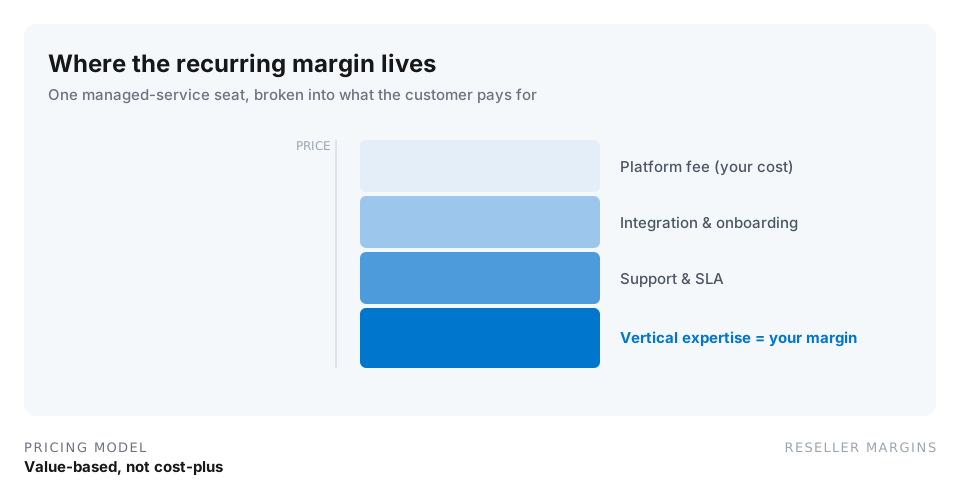
White-label. You license the platform, put your brand on it, and sell it to the client as your own product at your own price. The platform fee becomes a cost of goods, and everything above it is yours. This is the only one of the three where the margin is genuinely yours to set, because the client is buying an outcome from you, not a login screen from someone else.
What margins are actually realistic
Numbers vary by vertical and deal size, but the shape is consistent. Treat these as planning ranges, not promises.
On pure resale, expect to keep the 20 to 35 percent wholesale discount as gross margin on the platform line itself. That is thin once you subtract your support cost, which is why resale-only integrators tend to bundle heavy professional services around it to make the deal worthwhile.
On white-label managed services, the platform fee typically lands somewhere between 10 and 25 percent of what you charge the client, because the rest of the price is your integration, your support, your SLA, and your vertical expertise. That means gross margins of 60 to 80 percent on the service are normal and defensible, provided you priced on value rather than cost. We explained why cost-plus pricing quietly leaks margin every month in how to price an IoT managed service.
The lesson in the numbers: the platform is not where your margin comes from. Your margin comes from what you wrap around it. So the platform’s job is to be reliable, brandable, and cheap to operate, not to be the thing you mark up.
How the money actually moves
A healthy white-label arrangement has a clean flow. You pay the vendor a predictable platform fee, ideally per device or per tenant so you can forecast it. You bill your client a monthly managed-service fee that bundles platform, integration, support, and any hardware financing. The gap is your recurring margin, and it renews every month for the life of the deployment.
The trap is any vendor pricing that you cannot forecast. If your input cost floats with data volume or event count, you cannot safely quote a fixed price to your client, and you end up absorbing the variance. Predictable input pricing is what lets you offer predictable output pricing, which is what enterprise clients actually want to buy. This is why we treat pricing predictability as a first-class platform selection criterion in the best IoT platforms for system integrators to resell.
Setting up a program that compounds
If you are choosing which vendor to partner with, judge the program on four things, not the discount percentage.
Look for true white-label, so your client sees your brand end to end. TagoIO handles this through TagoRUN, a branded browser and mobile portal your clients log into as your product. Look for predictable per-tenant pricing so your quotes hold. Look for multi-tenant advantage, meaning one dashboard layout can serve many clients; TagoIO’s Blueprint dashboards exist for exactly this, so your fiftieth client costs about what your fifth did. And look for inherited compliance, because a platform that is already ISO 27001 certified and GDPR-ready lets you sell into regulated verticals without building a compliance program yourself.
Get those four right and the reseller math works on its own. Get the discount right but miss those four, and you have a coupon, not a company.
The honest summary: referral programs pay you once, resale programs pay you a spread, and white-label programs pay you a margin you control for as long as the deployment runs. Pick the structure that matches the business you actually want, then choose the platform that supports it. For the next steps, read how to differentiate your IoT managed service and the field view in how system integrators build IoT solutions with TagoIO.
Ready to model your own margins? Book a demo and we will map the white-label economics to your deal size, or start free and try the reseller setup yourself.