
Ten customers is a strange milestone for an IoT system integrator. It proves the business works, and it is exactly where growth usually stalls. The first ten arrived through founder relationships, got founder-quality attention, and each one received a solution built with care by the same two or three people. But the model that won those ten cannot win thirty, because it scales with headcount and heroics rather than with systems. Getting past ten is not a sales problem. It is an operating model change, and the firms that make it share four specific habits.
Habit 1: sell the product you already built
At ten customers, look backward before you look forward: which three deployments were the same solution wearing different logos? That overlap is your product. Package it, name it, price it, and sell that instead of bespoke scope.
Tank monitoring for fuel distributors. Cold-room compliance for food logistics. Submetering for commercial buildings. Whatever your pattern is, the discipline is saying no to work outside it, because every bespoke deal resets your delivery cost to customer-one levels. This is the difference between a profitable managed service model and a custom shop with a subscription invoice.
Habit 2: make deployment a checklist, not a project
The firms that scale treat delivery as manufacturing. Device provisioning is an API call or bulk import. Dashboards come from templates. Alerts and analysis scripts are parameterized. A new customer is a tenant created from a blueprint, and onboarding is measured in days with a written checklist someone junior can run.
The platform choice either enables this or fights it, which is why multi-tenancy and template support sit near the top of what to check before you commit. On TagoIO, tenant separation and white-label portals are the structure this runs on; the mechanics are the same ones covered in scaling from 10 devices to 1,000, applied across customers instead of within one.
Habit 3: let the platform do the watching
The ceiling nobody prices in: support and monitoring grow linearly with customers if humans do the watching. At ten customers your team still notices problems by looking. At thirty, either you hire a monitoring team or things get missed until the customer calls, and both outcomes eat the margin that made recurring revenue attractive.
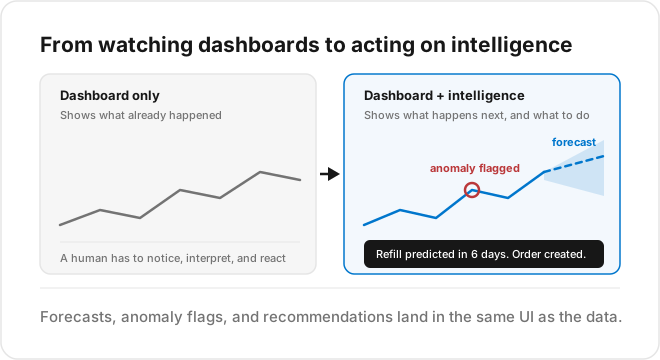
The way through is to move first response from people to the platform’s intelligence layer. Per-device baselines and anomaly detection catch the drifting sensor before the customer notices. Forecasts turn refills, battery replacements, and capacity problems into scheduled work instead of emergencies. Health checks page you about silent devices instead of relying on someone opening the right dashboard.
TagoIO’s analytics and AI run this inside the platform, and the output appears in the same UI your customers already use, which quietly changes what they are paying for: not charts, but the fact that problems arrive pre-diagnosed with a recommendation attached.
That shift also upgrades your pricing conversation. Monitoring-plus-intelligence tiers justify value-based pricing in a way that dashboard access never will.
Habit 4: put boundaries in writing before customer 11
Growth exposes every informal promise. The support expectations that were manageable across ten relationships become unpayable across thirty, so the move is contractual before it is operational: severity levels, response times, exclusions, and maintenance windows in a real SLA, tiered support plans instead of unlimited access to your engineers, and a renewal calendar someone owns. We walked through that shift in moving from one-time projects to recurring services. High-touch customers should be priced as high-touch, not absorbed.
The math that says when
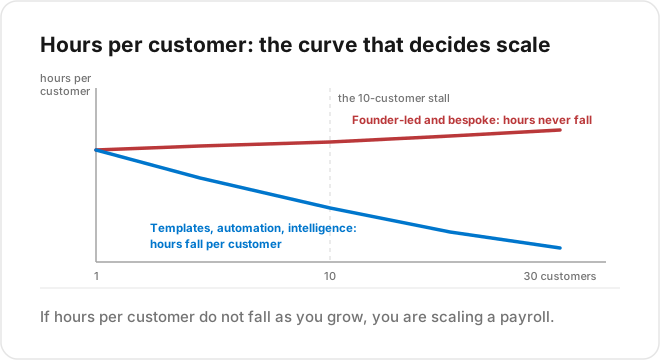
A useful gate: count the hours your team spends per customer per month on delivery, support, and monitoring. If the number does not fall as customers are added, you are scaling a payroll, not a business. The four habits above exist to bend that curve, and the platform’s automation and intelligence layer is what bends it hardest, because it is the only part that gets more valuable per customer without getting more expensive per customer.
Past ten customers, the winners look less like project firms and more like small product companies: one packaged solution, one deployment checklist, one intelligence layer watching every tenant, and margins that improve with each logo instead of eroding. The build-or-resell decision you made early either supports that shape or fights it.
TagoIO is built for integrators running exactly this model: multi-tenant, white-label, API-first, with analytics and AI in the box. Book a demo or start free.