
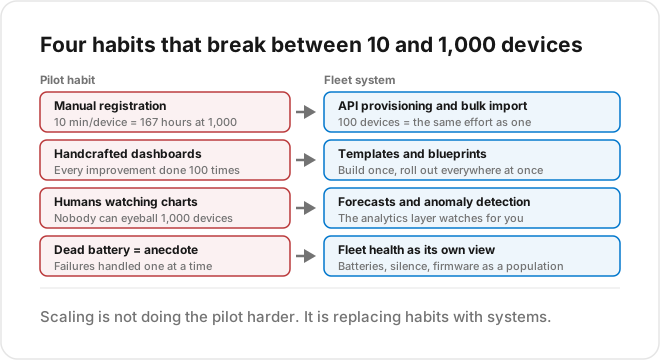
A 10-device pilot succeeds on effort. Someone registers each device by hand, builds a dashboard with care, watches it daily, and phones the site when a reading looks odd. That effort is exactly why pilots work: attention substitutes for process. But multiply by one hundred and every manual habit becomes arithmetic. Ten minutes of onboarding per device is 167 hours at a thousand. A person who can eyeball ten charts cannot eyeball a thousand. So scaling is not doing the pilot harder; it is replacing four manual habits with four systems before the growth arrives.
System 1: provisioning instead of registration
At pilot scale, devices are registered through the console, one by one. At fleet scale, onboarding must be an API call or a bulk import: serial number in, configured device out, with its type, tags, and owner assigned automatically. TagoIO’s API-first model and connector library exist for this. The target is boring and specific: adding 100 devices should take the same operator time as adding one.
While designing it, decide the tagging scheme early (site, customer, hardware revision, firmware version) because every fleet operation you run later, from queries to bulk updates, will lean on those tags.
System 2: templates instead of handcrafted dashboards
The pilot dashboard was lovingly assembled by hand. Do not build 100 more of them. Define one dashboard blueprint per device type or site type, and instantiate it from the template so improvements roll out everywhere at once.
The same discipline applies to alerts and analysis scripts: parameterized, not hardcoded to device IDs. This is the same build-once-apply-everywhere rule that separates profitable managed services from custom shops, and it is the single biggest predictor of whether device 500 costs less to run than device 50.
System 3: intelligence instead of eyeballs
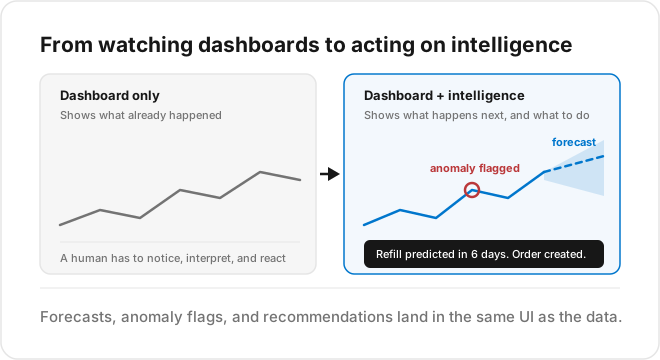
The third shift is the one most teams underestimate. At 10 devices, a human watching dashboards is the anomaly detection. At 1,000 devices, nobody is watching, and dashboards quietly become the place where problems are discovered late rather than early.
The replacement is an analytics layer that watches for you. Baselines that learn normal behavior per device, anomaly detection that flags the sensor drifting away from its history, and forecasts that turn “the tank is at 40 percent” into “the tank runs empty Thursday.” TagoIO’s built-in analytics and AI run this inside the platform, and the output lands in the same UI as the live data: a forecast band on the chart, a flag on the drifting device, an alert that carries a prediction instead of a threshold breach.
Dashboards remain useful at scale, but their job changes from monitoring to investigation. The monitoring belongs to the machine. We covered the techniques in how to detect anomalies in IoT sensor data using AI and forecast-based alerts.
System 4: fleet health as its own product
At pilot scale, a dead battery is an anecdote. At fleet scale, batteries, connectivity dropouts, and firmware drift are a statistical population that needs its own dashboard: devices silent for more than N hours, battery levels trending toward replacement, gateways carrying degraded traffic, firmware versions in the field.
Operations teams that manage 1,000 or more devices treat fleet health as a first-class view, separate from the customer-facing application, and wire alerts to it with the same seriousness as application alerts.
What about the platform bill?
Scaling 100x also multiplies whatever pricing meter you signed. This is where pricing model predictability stops being theoretical: per-device and tiered models scale linearly and survive the budget meeting; unmetered consumption surprises arrive precisely when the fleet succeeds. Run the 1,000-device bill before the growth, not after.
The sequence that works
Teams that scale smoothly do it in stages: pilot proves value, then provisioning and templates get built at around 50 devices, then intelligence and fleet health come online before 200, and the growth from there is repetition rather than reinvention. The teams that struggle bolt each system on after its absence caused an incident.
The honest test of readiness is a thought experiment: if 100 devices arrived tomorrow, would anything except revenue change? If the answer is a list of manual steps, that list is the roadmap.
TagoIO runs ten-device pilots and ten-thousand-device fleets on the same platform, so the systems above are configuration, not migration. Book a demo or start free.