
Every IoT platform lists an API on its features page, and every vendor will tell you theirs is excellent. But “best API” is an unfalsifiable claim until you define what best means for an integration you have not built yet, and the definition most buyers use, “it has REST endpoints and docs,” predicts none of the problems that actually kill integrations.
That discovery usually comes at the worst time: mid-integration, when you need to push data into a customer’s ERP, pull it into a custom app, or wire an event to a workflow, and the API turns out to expose half of what the UI does. Now you are building workarounds around the gaps instead of building your solution.
The useful move is to break “best” into five testable properties, look at which platforms hold them, and verify your shortlist against your hardest integration instead of your easiest.
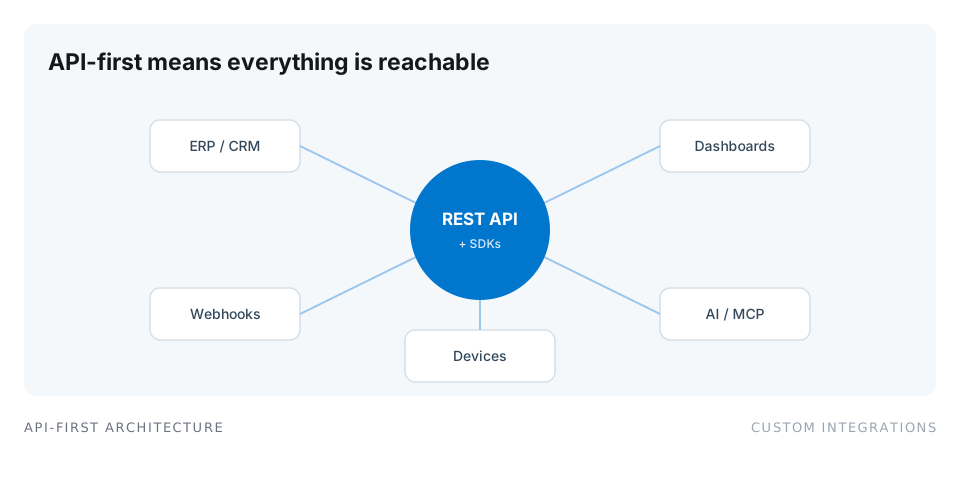
API-first versus API-attached
An API-first platform treats the programmatic interface as the primary way to interact with the system. The dashboards, the mobile app, the vendor’s own tools all call the same API you get. That has a real consequence: if the product can do it, you can do it through the API, because that is how the product does it too.
An API-attached platform builds a closed application, then exposes a subset of functions through an API later. The tell is asymmetry. Some things you can only do in the UI, some data is not retrievable, some resources are read-only when you need to write them. Every one of those asymmetries becomes a wall for a custom integration.
What “best API” actually means
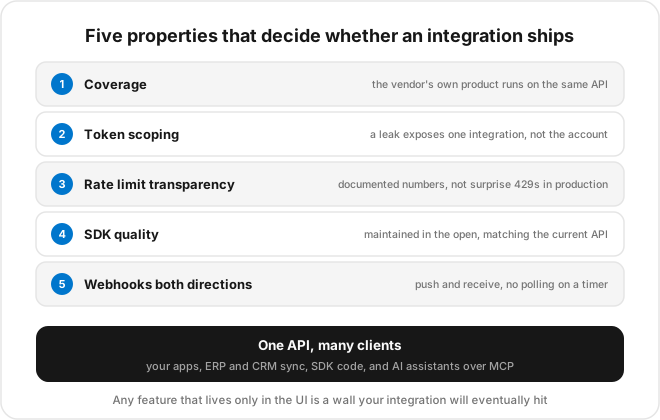
Five properties separate the two, and each one is testable.
Coverage comes first. The question is not how many endpoints exist but whether every feature of the platform is reachable through them: creating devices, reading and writing data, managing users and permissions, configuring dashboards and automation. Any feature that lives only in the UI is a wall your integration will eventually hit. The reliable tell is whether the vendor’s own product runs on the same API you get. If it does, coverage is structural rather than promised.
Token scoping is second. An integration should hold a token limited to exactly the devices and permissions it needs, so a credential leaked from a third-party system exposes one integration, not the account. All-or-nothing account keys are a blast-radius problem.
Rate limit transparency is third, and the most commonly ignored. Every hosted API has limits. The difference is whether they are documented with real numbers and surfaced predictably, or discovered in production as unexplained 429 responses during your first bulk backfill.
SDK quality is fourth. An official SDK in your language, maintained in the open and matching the current API, saves weeks. An SDK generated once and abandoned costs more than calling HTTP directly, because you spend your time debugging the wrapper.
Webhooks in both directions round it out. Real integrations push and receive: inbound endpoints so your systems and devices can send data in, outbound webhooks so platform events can trigger your systems without polling on a timer.
Data model access sits underneath all five. IoT integrations live or die on getting the right data out efficiently, so check that you can query by device, by variable, by time range, and by tag, and that bulk retrieval is supported.
Where the well-known platforms stand
AWS IoT Core has an enormous API surface, and IAM gives you the finest-grained access control in the industry, with limits documented down to the number. The cost is assembly: the API covers primitives, and turning primitives into an application means composing several AWS services yourself. It is a strong choice for teams with cloud engineers who already live in AWS, and the wider build-versus-buy trade is worth reading alongside it.
Open-source platforms like ThingsBoard and Kaa offer a different kind of API confidence: the source is readable, so coverage claims are verifiable, and self-hosting means the rate limits are whatever your deployment can sustain. The trade is that you operate the platform, and the API guarantees are only as good as your ops.
Blynk is well-liked when the product is a device plus a mobile app, and IXON has a solid reputation for remote access to industrial machines. Each is strong inside its intended shape and thinner once an integration steps outside it.
None of this is a ranking. Each option holds some of the five properties well, and the right fit depends on which properties your specific integration stresses.
Where TagoIO fits
TagoIO’s core claim is coverage by construction. The Admin console runs on the same REST API you get, so devices, data, users, dashboards, Actions, and Analysis scripts are all reachable programmatically, because that is how the product itself works.
Tokens are scoped, so an integration can be limited to the devices and permissions it actually touches. Rate limits are published in the documentation per service, so you can size a backfill before you run it. Official SDKs for Node.js and Python are maintained in the open on GitHub against the current API. The tag-based data model helps here too, because you can address whole groups of devices by tag rather than iterating device by device.
Both webhook directions are covered. Inbound, devices and external systems send data over HTTPS or MQTT, and payload parsers reshape it at ingest. Outbound, Actions and network integrations post to any URL when a condition or schedule fires, so your ERP, ticketing system, or data warehouse gets pushed events instead of polling.
Custom integrations this makes possible
When the API is genuinely complete, the integrations stop being special projects and become routine.
You can sync device data into an ERP or CRM so the business systems see the same reality as the operations team. You can build a custom application on top of TagoIO, using it as the IoT backend while you own the front end. You can use Analysis scripts to transform or enrich data server-side without standing up your own infrastructure.
The newest integration surface: an API for AI assistants
The most recent addition is the TagoIO MCP server, which is an API an AI assistant can use directly. Connect Claude or another MCP-capable assistant to your account and it can query devices, read data, and inspect resources on your behalf, which turns a class of one-off integration scripts into questions you just ask. It sits alongside TagoAI, the assistant built into the Admin itself: TagoAI for working inside the platform, MCP for the assistants you already use elsewhere. Both routes are compared in querying your IoT data in natural language.
The MCP server is also a quiet proof of the coverage argument, because it is simply another client of the same API. When the whole platform is programmatically reachable, new integration surfaces appear without new plumbing. We wrote about that layer in what MCP means for IoT.
Test it before you commit
Do not take any of this on faith, ours included. Pick the hardest integration you know you will need and build a thin proof of it on a free account: create a device through the API, write data and read it back filtered by tag and time range, mint a token scoped to that one device, and fire an outbound webhook from an event. Then read the rate limit page and check the numbers against your production volume.
If every step works against the live docs, the API is real. If any step needs a support ticket or a detour through the UI, you have found the wall early, which is exactly when you want to find it.
A platform’s API is the ceiling on everything custom you will ever build on it. Judge it on coverage, scoping, transparent limits, living SDKs, and two-way webhooks, and test the hardest case first. Read the TagoIO docs or start free and run the proof this afternoon.