
Adding a new device type is the most repeated task in any IoT operation, and its cost decides more than teams expect. A customer asks for a new sensor, a hardware vendor discontinues a model, a new use case needs a different measurement, and each time, someone has to make an unfamiliar device speak to the platform. Do it the slow way and every addition is a small engineering project with custom parsing code that someone maintains forever. Do it the fast way and it is an hour of configuration. Across a growing fleet, that difference compounds into the gap between a catalog you extend freely and one you avoid touching.
The fast path runs in the order below, which is also the order that saves the most time.
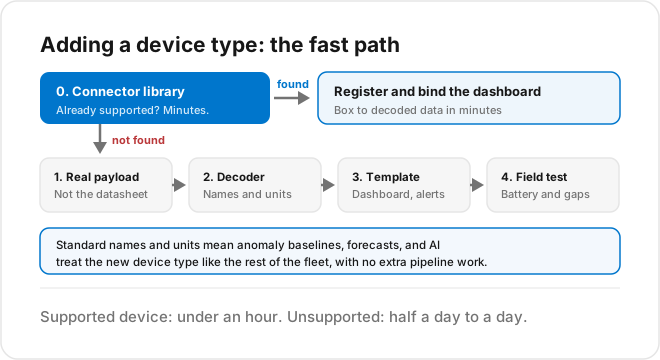
Step 0: check the connector library before writing anything
The fastest decoder is the one that already exists. Mature platforms maintain libraries of pre-built device connectors with the payload decoding, variable naming, and units already configured. TagoIO’s connector library covers hundreds of devices from the major LoRaWAN and cellular vendors, and a supported device goes from box to dashboard in minutes: pick the connector, register the serial number, data arrives decoded.
This step also belongs in procurement, not just engineering. When two sensors measure the same thing and one has a pre-built connector, the connector is worth real money over the device’s life. Integration effort is a hardware selection criterion, the same way battery life and radio performance are.
Step 1: get one real payload
If the device is not in the library, resist the urge to start from the datasheet. Get one physical device sending real uplinks first, because datasheets describe intent while the payload is fact, and the two disagree more often than vendors admit. Firmware versions change byte orders, fields shift, and a decoder written purely from documentation fails against production traffic in ways that cost an afternoon of confused debugging.
Step 2: write the decoder once, as configuration
A payload decoder does one narrow job: bytes in, named variables with units out. Keep it that narrow. On TagoIO the decoder lives in the connector as a small JavaScript function, and most LoRaWAN vendors publish reference decoders that need only light adaptation.
The discipline that pays off later: standardize variable names and units across device types. If three temperature sensors from three vendors all emit “temperature” in Celsius, everything above the decoder (dashboards, alerts, analytics) becomes reusable. If they emit “temp,” “t_c,” and “temperature_f,” every layer above pays the tax forever.
Step 3: template the application layer
The decoder makes data legible; the template makes it useful. Bind the new device type to a dashboard blueprint, default alerts, and any analysis scripts once, so the second unit of this device type inherits everything. This is the same build-once-apply-everywhere discipline that makes fleets scalable, applied at the device-type level.
There is a bonus that arrives free with standardization: the platform’s analytics and AI treat the new device type like every other one. Anomaly detection baselines start learning its behavior, forecasts run on its variables, and the new sensor shows up in the same intelligent UI as the rest of the fleet, with no extra pipeline work, precisely because the decoder emitted standard names and units.
Step 4: test with the field in mind
Before declaring the type supported, run one device through the unglamorous cases: a low battery report, a lost-connection gap, a value at the edge of the sensor’s range, and, for LoRaWAN, a confirmed downlink if the device accepts configuration. Ten minutes of this catches what the demo path misses.
What the numbers should look like
On a platform with a connector library and template support, a supported device type costs under an hour, and an unsupported one costs half a day to a day, most of it decoder verification. If additions routinely cost more, the friction is usually structural: no library, no template layer, or an API that makes bulk registration painful, and that is a platform evaluation finding, not a fact of IoT life.
A device catalog you can extend in an hour changes how the whole business behaves: sales says yes to hardware requests, operations swaps discontinued models without drama, and the fleet grows by configuration. TagoIO ships the connector library, the template layer, and the analytics that light up on top. Book a demo or start free.