
Most system integrators get paid the same way every time. You scope a deployment, install the hardware, stand up the dashboards, hand over the keys, and invoice for the project. The money is good. The customer is happy. And then the project ends, and your revenue from that customer drops back to zero.
The next month starts from nothing. You go find the next deal, win it, deliver it, and watch the revenue reset again. That is the treadmill most integrators live on, and it is exhausting in a way that has nothing to do with the technical work. You are only ever as healthy as your current pipeline.
The deployments you already shipped are sitting in the field, running every day, generating data and value for the customer. You built that. You understand it better than anyone. And you are getting paid nothing for it after the final invoice clears. That gap is where recurring revenue lives.
The problem with one-time project fees
A project fee is a transaction. It pays for the work once and ends. There is nothing wrong with the model on its own, but a business built only on transactions has two structural problems.
The first is that your income is tied to delivery capacity. You can only invoice for as many projects as your team can physically deliver. Growth means hiring, and hiring means more overhead chasing the same lumpy, one-time revenue. The second problem is that every January you start at zero. Last year’s wins do not carry forward. A great year buys you nothing in the next one except a reputation and maybe a referral.
Recurring revenue breaks both problems. It pays you for the deployments that are already live, without consuming delivery capacity, and it carries forward. Money you earned last quarter still shows up this quarter. That changes how the business behaves at a level the project model never reaches.
The recurring layers you can add
The good news is that you do not have to invent a new product to charge recurring fees. The deployments you already deliver create natural ongoing needs. Each one is a service you can package and bill monthly or annually.
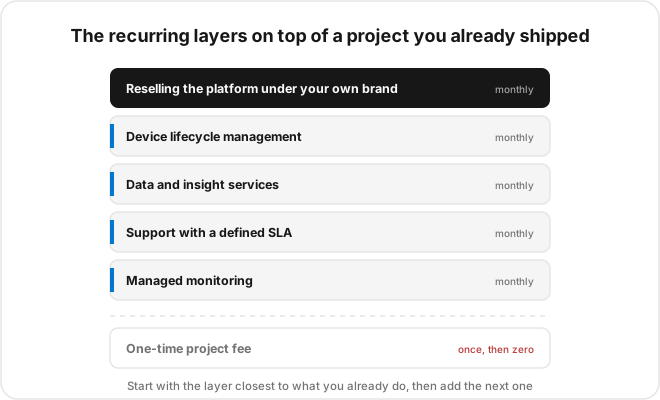
Managed monitoring. Someone has to watch whether the devices are online, whether data is flowing, and whether a gateway dropped off last night. The customer rarely wants to do this themselves. You already have the dashboards and the alerting in place from the original build. Turning that into a monitored service the customer pays for monthly is a small step from where you already are.
Support SLAs. When a device fails or a reading looks wrong, the customer calls someone. If that someone is you, charge for it on a defined response window rather than answering for free out of goodwill. A tiered SLA, with a guaranteed response time and a fixed monthly fee, turns the support you are probably already giving into a billable line. Getting the clauses right matters as much as the price, and what to include in a reseller SLA covers the language.
Data and insight services. The raw data is one thing. Turning it into reports, trend analysis, and recommendations the customer can act on is a higher-value service. A monthly summary of what the deployment is telling them, with your interpretation on top, is worth more than the data feed alone.
Device lifecycle management. Devices need firmware updates, replacements, recalibration, and eventual retirement. Managing that on an ongoing basis, so the customer never has to think about it, is a recurring service with a clear value the customer feels every time a device gets swapped without a fire drill.
Reselling the platform itself. The application layer the customer logs into every day is something you can package and bill as a recurring line under your own name. More on that below, because it is the layer most integrators overlook.
You do not need all of these. Start with the one closest to what you already do, price it, and add layers as the relationship grows.
Pricing recurring services so they hold margin
The mistake integrators make is pricing recurring services like discounted project work. They take an hourly rate, estimate the monthly hours, and bill that. The problem is that the hours are unpredictable and the margin disappears the first busy month.
Price recurring services on value and on outcomes, not on your time. A monitoring service is worth what the downtime it prevents costs the customer, not what an hour of your attention costs you. Set a fixed monthly fee tied to the scope of what you cover, like the number of devices or sites, and keep the fee independent of how many hours a given month happens to demand. Some months you do almost nothing. That is not the customer getting a bad deal. That is the deployment running well, which is exactly what they are paying you to maintain.
Build the cost of the underlying platform and tooling into the fee as a known input, the way a contractor builds in materials. If your recurring service depends on a platform you pay for, that cost is predictable per device or per site, so you can mark it up cleanly and the margin holds as you scale. A useful starting rule for the platform line is three to five times your own per-device cost, which leaves room for the support and integration you wrap around it. The trap is absorbing a variable cost into a fixed price without checking the math at volume.
What margin should hold at the end of that is a separate question, and the realistic ranges by model are set out in how IoT reseller programs work and what margins are typical.
Tier the offering. A basic monitoring tier, a standard tier with an SLA, and a premium tier with data services and lifecycle management gives the customer a path to spend more as they get more value, and gives you a higher-margin product to sell into the same account over time.
Moving existing customers on without a revolt
Adding a recurring layer to the next deployment is easy. The awkward part is the customers who already paid you once and are used to calling for free. Three moves make that conversation land.
Anchor it to an event rather than to a date. A contract renewal, a fleet expansion, a firmware migration, or a device batch reaching end of life all give the change a reason that is about their deployment, not about your revenue targets. A price change with no trigger reads as a price change. A price change attached to work reads as a plan.
Attach something new to the fee. If the monthly invoice buys exactly what they were getting for free, you are asking them to pay for the status quo. Bundle in the thing they keep asking for: a monthly report, faster response, proactive replacement before a device dies. The fee is easier to accept when it arrives with a capability rather than only a number.
Leave a decline path. Some customers will say no, and a hard cutover turns that into a lost account. Offer a lower tier or a best-effort option with no guaranteed response, and be plain about what it does not include. Most who start there move up the first time an outage makes the difference obvious.
There is a fuller treatment of the shift, including the contract changes it implies, in moving from one-time projects to recurring services.
Why recurring revenue raises the value of the business
Cash flow is the obvious benefit, but it is not the most important one. Recurring revenue changes what your business is worth.
A business that lives on project fees is valued on its current pipeline and its people. There is little to sell beyond goodwill, because the revenue does not continue without the next deal. A business with a base of recurring contracts is valued on that base, often at a multiple of the annual recurring revenue, because a buyer is purchasing income that continues after the sale.
That difference is large. Two integrators with the same total revenue can be worth very different amounts if one earns it from one-time projects and the other earns a meaningful share from recurring contracts. The recurring business is more predictable, easier to plan around, and far easier to sell or raise against. You are not just smoothing your cash flow. You are building an asset.
How TagoRUN turns the platform into a recurring line
The layer most integrators leave on the table is the platform itself. The customer logs into a dashboard every day, manages devices, gets alerts, and pulls reports. That application layer has ongoing value, and it is something you can own commercially without building or operating it.
TagoRUN lets you white-label and resell TagoIO as a branded product under your own name. The customer sees your brand, your colors, your domain. You set the pricing and bill the recurring fee. TagoIO runs the underlying platform, the storage, the device management, the APIs, and the compliance posture, including ISO 27001 certification and GDPR alignment, so you are not carrying the on-call, the patching, or the scaling that comes with operating a platform yourself.
That is the cleanest recurring layer available to an integrator, because the value is already there. The customer is already using the application every day. TagoRUN turns that daily use into a recurring line you own, with a predictable platform cost underneath it that you can price around, and none of the operating burden of running the stack.
The project that ends is the project that pays you once. The platform the customer keeps using is the one that can pay you every month. Pick a recurring layer, price it to hold margin, and start with the next deployment you ship.