
The habits that make a ten-device pilot succeed are the exact habits that make a thousand-device deployment collapse. Naming each device by hand, building a dashboard per site, checking on things by looking: all fine at ten, all fatal at a thousand. The pilot works because a human can hold the whole system in their head. Scale removes that option.
This is why so many IoT projects stall between pilot and production. The technology proved out, but the operating model did not scale with it, and suddenly every new batch of devices adds linear work: more naming, more dashboards, more manual checking. The team becomes the bottleneck.
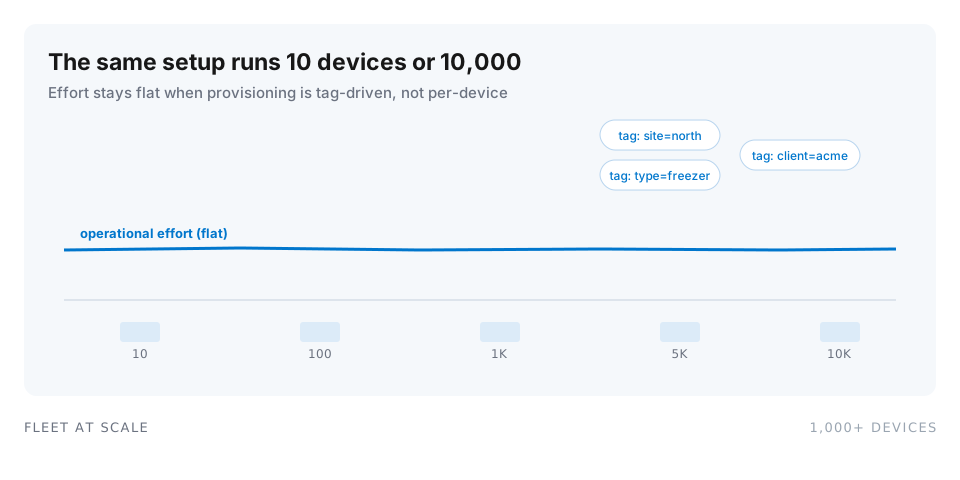
Teams that run large fleets successfully do one thing differently. They make the per-device effort approach zero, so adding the thousandth device costs about what the tenth did. Here is how that works in practice.
Provision by template and tag, never by hand
At scale, the first thing to die is manual device creation. You cannot click “add device” a thousand times, and you should not.
The pattern that scales is bulk provisioning against a template, where a new device inherits its configuration, its payload parser, and its metadata automatically. The key is tags: every device carries structured metadata like site=north, type=freezer, client=acme. Tags are not decoration. They are how you address the fleet. Instead of managing a thousand devices, you manage a handful of tag-defined groups, and every device that matches a group inherits its behavior. TagoIO’s model is built around this, which is why the best IoT platform for managing thousands of devices comes down to whether provisioning is tag-driven or manual.
The test of good provisioning is simple: adding 500 devices should be a bulk operation, not 500 operations.
One dashboard layout for the whole fleet
The second habit to break is one dashboard per site or per client. Build fifty dashboards by hand and you now maintain fifty dashboards by hand. Change one thing and you change it fifty times.
The scalable pattern is a single templated layout applied across the fleet. TagoIO Blueprint dashboards use tags to bind one layout to many devices: you design the freezer view once, and every device tagged type=freezer gets its own instance of it automatically. A new site appears in the dashboard the moment its devices are tagged, with no layout work. That is the difference between a dashboard system that scales and one that becomes a maintenance job.
Monitor the fleet, not the devices
At ten devices you watch the devices. At a thousand you cannot, and trying to is how real problems hide in plain sight. The shift is from watching values to watching for exceptions.
In practice that means monitoring by exception and by aggregate. You want an at-a-glance view of fleet health, how many devices are online, how many are in alarm, how many have gone silent, and automated alerts that surface only the devices that need attention. TagoIO Actions handle the alerting: define the condition once, apply it across the tagged fleet, and let the system tell you which devices broke rather than making you look. A device that stops reporting should page you; you should never discover it by scrolling.
This is also where AI starts to help at scale. With the TagoIO MCP server, you can ask “which devices haven’t reported in 24 hours and what do they have in common,” and get an answer grounded in the real fleet instead of building another report. We cover that in querying IoT data in natural language.
Plan for firmware and updates from day one
The last thing that separates a managed fleet from an unmanaged one is updates. A thousand devices will need configuration and firmware changes, and doing that safely means staged rollouts, not a flip of the whole fleet at once. Group by tag, push to a canary group first, confirm health, then roll wider. The same tag structure that provisions your fleet is what lets you update it in controlled waves.
The through-line
Managing a large fleet is not about a bigger version of your pilot’s process. It is a different process, built so per-device effort stays flat as the count climbs. Provision by template and tag, drive every dashboard from one layout, monitor by exception and aggregate, and roll updates in tag-based waves. Get that operating model right and the jump from pilot to a thousand devices stops being the cliff that kills the project.
If you are staring at that cliff now, the simplifying IoT deployments use case shows a team that crossed it, and how TagoIO works explains the tag model underneath. Ready to build the scalable version? Start free or book a demo.