
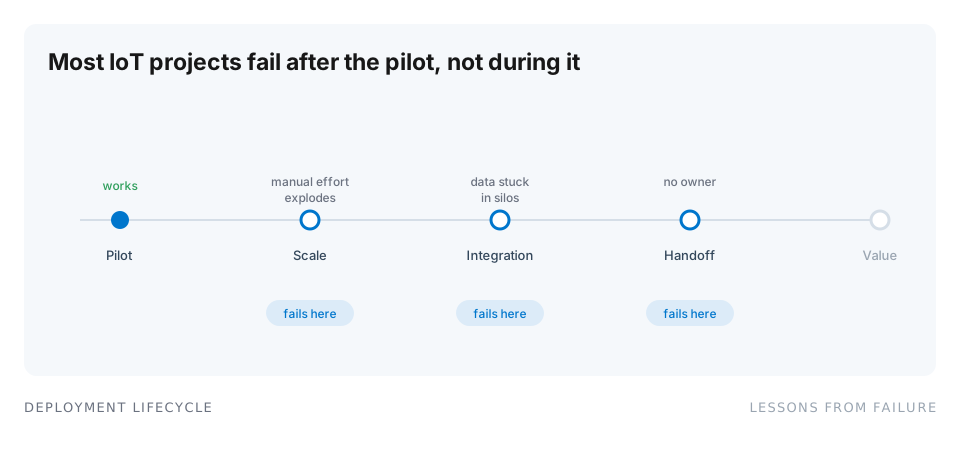
The uncomfortable truth about IoT failure is that the pilot almost always works. Ten sensors, one dashboard, a proud demo to stakeholders, everyone impressed. The failure comes later, quietly, in the gap between “the pilot worked” and “the system runs the business.” By the time it is obvious, a lot of money has been spent, and the post-mortem tends to blame the technology when the technology was rarely the problem.
We have watched enough deployments stall to see the pattern, and it is worth naming plainly, because the lessons are not the ones people expect. Failed IoT projects do not usually die from a bad sensor or the wrong protocol. They die from operating-model gaps that a successful pilot actively hides.
Here are the failures that actually kill deployments, in the order they tend to strike, and what each one teaches.
Lesson one: the pilot lied to you about scale
The most common failure is mistaking a working pilot for a working system. A pilot succeeds precisely because it is small enough for a human to run by hand. Every device named manually, one dashboard, someone eyeballing the data. None of that survives contact with a thousand devices.
The lesson is to design the operating model for the target scale, not the pilot scale, from the start. If provisioning, dashboards, and monitoring are manual in the pilot, they will break at scale, and you will not notice until you are already committed. We wrote the constructive version of this in how teams actually manage 1,000+ devices in the field: tag-based provisioning and templated dashboards so per-device effort stays flat. The failed projects are the ones that tried to scale the pilot’s manual habits and drowned in them.
The test to apply early: if going from 10 to 1,000 devices multiplies your team’s workload, you have a pilot, not a system.
Lesson two: the data got stuck in a silo
The second killer is integration, and it is subtle because the IoT part can be working perfectly while the project still fails. Data flows into a dashboard, the dashboard looks great, and then someone asks to get that data into the ERP, or the maintenance system, or a customer’s app, and it turns out the platform cannot cleanly hand its data to anything else.
An IoT deployment that cannot integrate with the systems that run the business is a science project. The value of sensor data is realized when it triggers a work order, updates inventory, or feeds a decision somewhere else, and that requires a platform whose data is genuinely reachable. This is why an API that actually fits custom integrations is not a technical nicety, it is the difference between a dashboard and a system of record. The failed deployments picked a platform whose API was an afterthought, and hit the wall when they needed the data to leave.
Lesson three: nobody owned it after launch
The third failure is organizational, and it is the quietest. The project team builds the deployment, declares victory, and moves on. No one is clearly responsible for the running system. Alerts go to an inbox nobody watches. A sensor dies and is not noticed for a month. Slowly, trust in the data erodes, people stop relying on it, and the deployment becomes shelfware that is still being paid for.
The lesson is that a deployment is not done at launch, it is done when there is a named owner, a monitoring routine, and a handoff that actually transferred knowledge. Handoff is a deliverable, not an afterthought. The projects that last are the ones where someone owns fleet health on day 31, not just day 1.
Lesson four: it solved a technology goal, not a business one
Underneath the other three is often the root cause: the project was scoped around “deploy IoT” rather than a specific business outcome with a number attached. When the goal is vague, there is no clear finish line, no way to prove value, and no defense when budgets tighten. “We connected the sensors” is not an outcome. “We cut spoilage from 6 percent to under 2” is.
The lesson is to define the outcome and its metric before buying anything, then work backward to the smallest deployment that proves it. Projects anchored to a business number survive scrutiny. Projects anchored to a technology milestone get cut at the first budget review.
What the failures add up to
Put the lessons together and a clear picture emerges. IoT projects rarely fail because the technology could not do it. They fail because the pilot hid the scaling problem, the data could not leave its silo, no one owned the running system, or the goal was never a business outcome in the first place. Every one of those is preventable, and none of them is about picking a fancier sensor.
If you are planning a deployment, the honest move is to design for scale, integration, ownership, and outcome before you fall in love with a successful pilot. The simplifying IoT deployments use case shows what it looks like when a team gets those right, and how system integrators build IoT solutions with TagoIO covers the delivery model that avoids the handoff trap.
Failure teaches the same lesson every time: the platform and the operating model have to be built for where you are going, not where the pilot stopped. Want help designing for scale from the start? Book a demo or start free.